Showing posts with label NYC Museums. Show all posts

Vintage Gems of New York


On a recent visit to the Brooklyn Museum I visited the Steinberg Family Sculpture Garden. Dedicated in 1966, it hosts a pre-eminent collection of terracotta, stone, and metal architectural elements salvaged from now-demolished structures throughout the metropolitan area and reinstalled outside the museum's Norman M. Feinberg entrance. Most of these remarkable objects date to the period between 1880 and 1910, recording a great era in the cultural, architectural, and industrial history of New York City.


The Brooklyn Museum, located at 200 Eastern Parkway, Brooklyn, New York, is the second largest art museum in New York City.  The museum opened in 1897, and the 560,000-square foot building houses a permanent collection including more than one-and-a-half million objects, from ancient Egyptian masterpieces to contemporary art.


The outdoor collection offers varied examples of the forms created to enrich the facades of residential and commercial buildings. Scrolls and garlands, fruit and flowers, cornucopias and shells, and geometric and foliate patterns abound, as do human and animal forms and fantastic creatures all simplified into architectural units such as keystones, friezes, moldings, lunettes, and plaques, that once adorned buildings in New York City.


Much of the work was executed by anonymous stone carvers, mostly immigrant workers from the United Kingdom and, later, Italy, who traveled from building site to building site. By the turn of the century, however, a large portion of this work would no longer be done by hand, as factory-produced terracotta tiles replaced most of the hand-carved stonework on New York buildings.
A number of the objects in the collection were also designed by well-known artists and architects, including Louis Sullivan; McKim, Mead and White; Irwin S. Chanin, and Gutzon Borglum.


I'd like to show you some of the significant works of sculptural art in the garden:


Adolph Alexander Weinman (American, 1870–1952). Night, Clock Figure from
Pennsylvania Station, 31st to 33rd Streets between 7th and 8th Avenues, NYC, circa 1910

Information about this sculpture from the museum online catalog:

"This slumbering female figure once stood beside a huge clock above an entrance to the original Pennsylvania Station. The vast complex, completed in 1910, was designed by Charles Follen McKim and modeled after the Roman Baths of Caracalla. Each of four pedestrian entryways to the terminal was surmounted by a clock flanked by two allegorical figures representing time. Day held a sunflower, and the hooded Night, seen here, bears a drooping poppy. The terminal building was demolished in 1963. This sculpture was retrieved from landfill in the New Jersey Meadowlands."


Replica of the Statue of Liberty, circa 1900. Made by W.H. Mullins
 (Salem, Ohio, 1890–1928). Zinc galvanized sheet steel over iron frame, height: 367 in

Information about this sculpture from this page of the website catalog:
 "Perhaps no American symbol is more widely recognized or powerfully expressive than Liberty Enlightening the World—the Statue of Liberty, erected on Bedloe’s Island in New York Harbor in 1885. This thirty-foot replica was commissioned around 1900 by the Russian-born auctioneer William H. Flattau to sit atop his eight-story Liberty Warehouse, then one of the highest points on Manhattan’s Upper West Side. Flattau combined his entrepreneurial spirit with pride in the adopted country in which he had prospered."

A popular fixture of the Upper West Side for more than a century, this Statue of Liberty replica was removed in 2002 when the warehouse was sold and renovated for use as an apartment building.


Four pair of Pegasus Figures Cica 1934, Attributed to Harry Lowe,
from the New York City Fire Service Pumping Station, Neptune Ave and West 23rd Street,
Coney Island, Brooklyn, New York


These sleek modernist versions of Pegasus, the flying horse of classical mythology, once flanked the entrances to the New York City Fire Service Pumping Station that still stands on Neptune Avenue between West Twenty-third and West Twenty-fourth Streets. The station boosted water pressure for fire fighting in outlying areas of Brooklyn. These four pairs of winged horses arise from stylized curving forms that suggest waves or clouds. Their compact double profiles reflect the Art Deco style of the industrial building whose entrances they once adorned. The streamlined design style was widely used in the 1920s and 1930s. When the building was modermized they were sadly removed from the facade.


Hugo Haase (German, 1857–1933).
Lion, from the El Dorado Carousel, Coney Island, Brooklyn, circa 1902

Information about this sculpture from the museum's website catalog:

"This ferocious creature was one of a trio of rearing lions that originally pulled a chariot atop the entrance pavilion to the giant El Dorado Carousel at Coney Island. Germany’s leading amusement-ride manufacturer, Hugo Haase of Leipzig, built the spectacular carousel in 1902 for Wilhelm II, emperor of Germany and king of Prussia. In 1910 it was imported by Coney Island empresario George Tilyou and installed near the Dreamland amusement park, at West Fifth Street and Surf Avenue. Though only one of several independent carousels at Coney Island, the El Dorado was, according to carousel expert Frederick Fried, “the most ornate, most publicized, and one of the largest” in America. The carousel and its entrance pavilion were relocated several times and eventually separated. The latter was dismantled in 1964. The carousel is still in use at the Toshimaen Amusement Park in Tokyo."


Architectural ornament, early 20th century, from one of several insurance buildings
 at Liberty and William Streets, Manhattan.
Information about this sculpture from the museum's online catalog:

"Winged Dragon Chimera -This fierce and fantastic creature, sitting on his haunches and clutching a shield, seems to be a cross between two mythical monsters: a griffin (with an eagle's head and wings and the body of a lion) combined with a dragon. This lively sculpture came from the facade of a building that formerly stood in the financial district in Lower Manhattan."


"Atlantes Figures," circa 1899, from the Hugh J Chisholm residence,
formally at 813 Fifth Avenue, Manhattan.

Information from the Museum's online catalog:

"Set of four limestone Atlantes (sculptural supports in the form of a man). Four bare-chested men with drapery around their waists, attached at back to pilasters, and supporting a now missing ledge with arm or arms. Two hold both hands over heads; two have one arm above head, other arm holding drapery. The figures adorned the facade of the Hugh J. Chisholm house until 1961, when the structure, along with two adjoining houses, was torn down to make way for an apartment building."


A close up of one of the Atlantes figures.


Unfortunately, many other examples of vintage New York City architecture languish in limbo behind the museum's parking lot fence. Over ten years ago, the Brooklyn Museum dismantled the sculpture garden during a reconstruction of its rear entrance and expansion of the parking lot, and reinstalled a far sparser sculpture garden, using the more notable fragments shown earlier in this post.


Other pieces with less historical value or identification were left on wooden pallets in a rubble pile and left to the elements. I never visit the museum without peeking through the chain link fence at these objects as I find them beautiful and interesting and I feel sad about their neglect.


A very interesting article about these artifacts can be read on this Atlantic Magazine link. The Brooklyn Museum opened a forum for questions after the Atlantic article was printed, which can be read at this link. It seems with current budget constraints museums are hard strapped to provide the funding to showcase collections such as these. Unfortunately, The New York City Landmarks Preservation Commission  was also faced with having to deal with losing their architectural salvage program due to budget constraints, and they recently offered their artifact collection at auction.

Hopefully, there will soon be a solution to what to do with future pieces of vintage decorative and functional New York City architecture so their beauty will be preserved for future generations. The Preservation League of New York State  is dedicated to the protection of New York’s diverse and rich heritage of historic buildings, districts, and landscapes. It is now working to provide a united voice for historic preservation.  Since 1999, the Preservation League has highlighted New York’s most threatened historic resources and their Intervention Program allows the Preservation League to intervene directly when historic buildings are threatened with disinvestment, neglect, and demolition.

 What is being done in your area to preserve historic architecture and landmarks? It is something we should all be concerned about!

I am adding this post to the "Mosaic Monday" event on Mary's blog The Little Red House and the "Outdoor Wednesday" event on Susan's blog A Southern Daydreamer. Thanks to both hosts!

Bookmark and Share

The Schenck Houses in the Brooklyn Museum

There are many historical homes still standing in Brooklyn, New York, that date back to early days when it was a Dutch settlement. I've shown the Pieter Claesen Wyckoff House, the Wyckoff Bennett House, the Hendrick I Lott House, and the Lefferts Historic House Museum before on my blog, which all remain on, or near, their original foundations. Now I'd like to show two homes that were dismantled and then reconstructed for display in the Brooklyn Museum to preserve them for all time


The Jan Martense Schenck house is one of the oldest house in the United States. It was built around 1675 in what is now known the Mill Basin/Mill Island neighborhood of Brooklyn, part of the town of Flatlands. Flatlands was one of five towns--Bushwick, Flatbush, Flatlands, Gravesend, and New Utrecht---to become the borough of Brooklyn. Jan Martense Schenck, the man who built this house, arrived in New Netherland in 1650. On December 29, 1675, he purchased the land on which he built the house, along with a half interest in a nearby gristmill.


The house survived through the first half of the 20th century in its original location, but in 1952 the house was at risk of demolition because of development in the area. The Brooklyn Museum arranged to have it dismantled and stored for a decade, until preparations for installation of the house could be made. On April 26, 1964, the house was opened to the public inside the Decorative Arts Gallery.

My photo enlargement  from an informational placard in the museum

If you remember my blog post about the Beautiful Houses in Mill Basin, Brooklyn, you can see how this neighborhood now looks. All of the marsh land has been filled in and the land where the Schenk house stood on is now a school yard.  I grew up in this area of Brooklyn, and while I don't remember the Jan Martense Schenk house being here my older brother and sister do!  They said it was in ruins and covered with vines.

My photo enlargement from an informational placard at the museum

During the 275 years that the house stood in its original location, it underwent many changes to accommodate the needs of new generations. In the museum photo above, the Jan Martense Schenck House is shown with the porch and dormers which were added by about 1825. When reconstructed in the museum it was returned to the original two-room structure.


Part of the exterior clapboard siding has been removed in one section to show a reconstruction of the brick nogging originally used to insulate the house. The museum web site states:  "For many years the house was painted gray. Recent analysis of the exterior paint layers on the original clapboard surviving in the corner at the short end of the building revealed that the house was originally white and then red. Since the interior of the house is interpreted to the first decades of the eighteenth century, we decided that the house might have received its second coat of paint, the red layer, by that time."


None of the original Dutch colonial furniture owned by the Schencks is known to have survived. The curators have assembled the interior-decorations and furniture using objects that would be typical in an interior of a prosperous family of Dutch descent living in colonial English Flatlands. The rooms are viewable behind glass, so unfortunately there is some glare on the glass in my photos.

A linen press.


This informational placard by the second entrance to the house describes the more formal room of the house. (please double click on the photo to enlarge it)


Notice the built in bed boxes with heavy drapes on the fireplace wall on the left side of the room. Staying warm in winter was a challenge, and this was a way to block drafts and utilize radiant heat.


A beautiful wardrobe from the 1600's that would be the type that would have been in a house such as this.
The Schenck family owned the house for three generations, finally selling it in 1784. It was abandoned and in disrepair when rescued by the museum.  How fourtunate that the Brooklyn Museum had the foresight to preserve for all time such a treasure from Brooklyn's past.  It tells the almost forgotten story of the people who were among the first settlers in the United States.

The next house in the exhibit is the house of Nicholas Schenck (1732–1810), the grandson of Jan Martense Schenck,  in what is now the Canarsie section of Brooklyn. It was built about 1775, and installed in the museum in 1929.


The house was heavily remodeled in the early nineteenth century and is therefore installed here as it might have looked about 1830 when Nicholas Schenck, Jr. (1765–1836) lived in it with his family.


A model of what the house looked like when it was on its original location.


Let's enter the Dutch door and enter the house.


The color of the woodwork is based on fragments of paint found under the fireplace mantel and accurately reproduces the original color.

The dining room.

The furnishings of the house, like its architecture, are a mixture of both eighteenth and nineteenth century styles and traditions.

Parlor/living room

Large fireplaces, considered inefficient by 1830, have been closed up and replaced as sources of heat by cast-iron stoves.


The Master bedroom

A child's bedroom.
Although small and rustic, both houses revealed that life was not that much different in the 17th, 18th and 19th century, than modern day life. The kitchen was the heart of the home, and adequate dining accommodations and comfortable bedrooms were important assets to have. 

In addition to the Schenck houses the museum also had other period rooms to view and many decorative items on display.


17th and early 18th century China and silver pieces

17th century glassware

The Brooklyn Museum's collection of decorative arts is considered one of the most important in the country.  It is a fascinating way to look at how life was lived over 300 years ago.

For anyone interested in antiques, American architecture and interior design the Decorative Arts galleries, the American Identities: A New Look gallery and the Luce Visible Storage Study Center in the Brooklyn Museum are not to be missed!


Bookmark and Share

Ancient Egyptian Art at the Brooklyn Museum


The Brooklyn Museum's collection of ancient Egyptian art, one of the largest and finest in the United States, is renowned throughout the world. The Egyptian collection is exhibited on the Museum’s third floor in the Martha A. and Robert S. Rubin Galleries and in Egypt Reborn. Ancient Near Eastern art is exhibited in the Hagop Kevorkian Gallery.  I have viewed these exhibits many times in my life. First, as a young teenager into adulthood,and then again many times when I brought my own children to the museum. As often as I've seen the Egyptian exhibits, I am never without a sense of wonder and awe at their history and beauty. The museum does a wonderful job rotating objects from the collection archives, so there is always a new surprise to see as well as standard favorites.

(All photos will enlarge to allow for a closer view by clicking on it once, and then click on it again when it re-opens)

A relief of Ramesses II

The museum began acquiring Egyptian antiquities at the beginning of the twentieth century, through purchases, gifts and donations, and archaeological excavations.
.
A photo mosaic of some of the many ancient Egyptian artifacts on display.

The museum collection now comprises a wide variety of material from every period of ancient Egypt’s long history, beginning with the Predynastic Period, about 3500 B.C., to the Coptic and Byzantine eras some four thousand years later. The Brooklyn Museum has also conducted archaeological excavations at the Temple Precinct of the goddess Mut at Karnak since 1976.

A Broad Collar from the Old Kingdom

 8,536 objects in the museum's possession can be viewed on the online collections page at this link.


The goddess Bastet, who was often depicted as a cat.

As a cat fancier, I always look for an example of Bastet when I visit an exhibit of ancient Egyptian art. It is usually easy to find a statue of her on display, as she was a popular goddess.


The Brooklyn Museum’s Mummy Chamber explores how and why mummies were made, as part of the strategies employed by ancient Egyptians in their quest to defeat death

The coffin and mummy of Thothirdes - Late Period, Dynasty 26


The exhibit includes a variety of coffins from different periods and various figurines and amulets buried with the mummy.


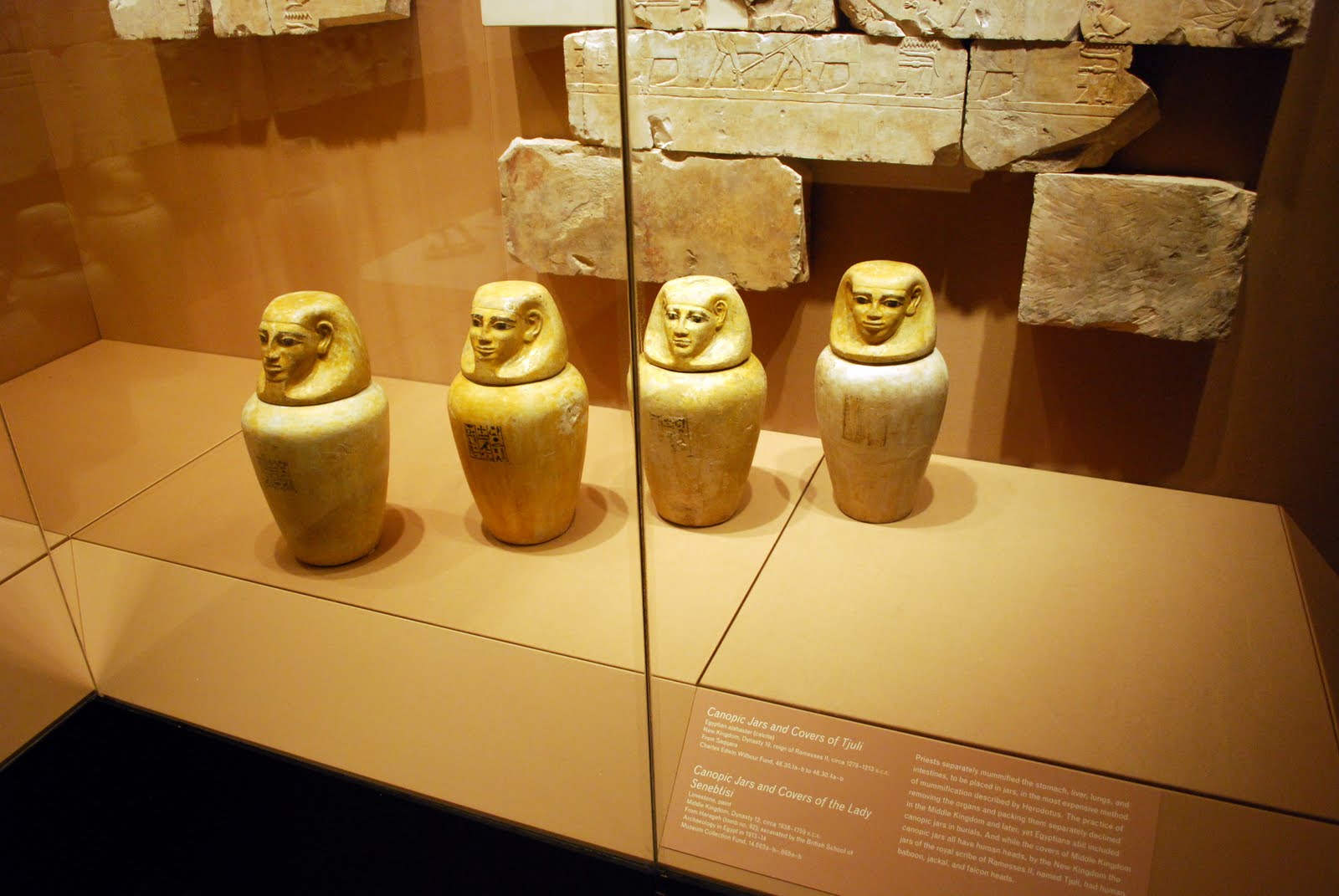
Canopic jars and lids of Tjuli -New Kingdom, Dynasty 19

Canopic jars were intended to hold the separately mummified internal organs. Later, at less extravagant funerals, they were never hollowed out to hold the organs, but were still symbolically included in the tomb.

On display near the mummy chamber was a twenty-five-foot-long "Book of the Dead" papyrus that provided the spells ensuring entrance into the next world and survival there.


A short, but interesting, video about the Book of the Dead of Sobekmose. Acquired in 1937 and never before on pubic display. It has undergone more than two years of conservation.


Inscribed stone slabs, called stelae, were placed in tombs to remember the dead, offer prayer for them, and symbolically provide food, drink and clothing for eternity. Small figurines called shabtis were also placed in tombs, each of which was assigned to “work” in the afterlife.

Animals considered sacred were also mummified and buried. An Ibis mummy coffin on the left and cat mummies and coffins on the right.


Face of Amunhotep II, New Kingdom, Dynasty 18


Akhenaten and His Daughter and Their Offering to the Aten
Late Kingdom, Dynasty18


The Brooklyn Museum also contains selected works of Ancient Near Eastern Art, including Assyrian Reliefs. There are twelve massive carved alabaster panels like the ones seen above, that line the walls of this gallery.  They are but a small sample of the hundreds of such reliefs, all originally brightly painted, that once adorned the vast palace of Ashur-nasir-pal II, one of the greatest kings of ancient Assyria. They were completed in 879 b.c. in what is now Iraq, slightly north of Baghdad.  The story of how these reliefs came to Brooklyn can be read on the museum web site at this link.


I'm sure you can see why the Ancient Egyptian exhibits at the Brooklyn Museum are among my favorites. I feel privileged to have seen so much of the collection over my lifetime living in Brooklyn and it is nice to know that these treasures are being maintained and preserved for future generations.

To see my introduction post about the Brooklyn Museum click here, and to see my post about a few special exhibits I saw at the museum click here.

I am linking this post with Mosaic Monday on Mary's blog at The Little Red House. Click on the link to see links to Mary's beautiful photo mosaic and links to all all the participating blogs.


Bookmark and Share