Showing posts with label Arts / crafts. Show all posts

Hands On Dumbo

Before I tell you about another fun Etsy adventure a friend and I went on this week, I would like to thank everyone who commented on my last post about the fires that are ongoing in Colorado, and for your prayers. My family is safe, but my heart goes out to all the people who have lost their homes and businesses. Thankfully, up to now, loss of life from the varied fires has been small, but extreme danger remains. I hope all the Western states that need a good, long, soaking rain get it very soon, so that the fires will be fully extinguished and the danger of future fires will finally be over.


Now on to "Hands On Dumbo"! The headquarters of the popular online e-commerce handmade and vintage craft store called Etsy, is located in Brooklyn, NY, in a friendly little neighborhood called DUMBO, which is an acronym for Down Under the Manhattan Bridge Overpass. They, along with the Dumbo Improvement District, hosted a "Hands on DUMBO" event to allow participants to explore this unique Brooklyn neighborhood and take part in craft projects hosted by seven local businesses.


The Hands On DUMBO meeting began at the Archway area of the Manhattan Bridge, with music being played by DJ Colleen Crumbcake, photos at a photo booth, and a pinprick card project led by Etsy staff. A map of the DUMBO neighborhood was also handed out listing the locations of all the evening’s crafting festivities.


The Archway is actually part of the Manhattan Bridge overpass and has been turned into a unique meeting place! The 7,000 square foot space has seating, lighting, electricity, and free wifi, all provided by the DUMBO Improvement District year round for use by the community. It is also available for use for special events.


The entire Hands On Dumbo event was free, with pre-registration. The main office of Etsy on 55 Washington Street also hosts a free open monthly craft night called "Etsy Labs," that offers a wide assortment of different crafts projects and tutorials.  You can read a prior post I wrote about visiting the Etsy Lab for a felting workshop on this link.


This sign shows the line up of events hosted by seven local businesses. We could chose to personalize a sweat band, and try out boxing and jump rope moves with the trainers at the famous Gleason’s Gym, or visit Pomme to create an animal mask with Anna Donado of the ETSY store goose grease. The store Recycle-A-Bicycle had instructions on how to make a rubber tire pouch from this ETSY Labs online How-Tuesday post, and One Girl Cookies and learn a marbling cookie decorating technique. Since my friend and I also wanted some time to explore the DUMBO neighborhood a little on our own, and go shopping, we decided to participate in the following three nearby Hands On DUMBO activities:


At Neighborhoodies, located at 26 Jay Street, we made hand-sewn patches, just like they produce for their custom sweatshirts and tees for men, women and children, which they sell individually through internet orders, along with bulk orders. They showed us the process of ironing on decals and then surrounding the design with stitches. We loved their space on the ground floor of an old warehouse, and they graciously allowed us to walk around to see more.


At the Brooklyn Roasting Company located at 25 Jay Street, we learned how to turn a coffee can into a DIY ice cream maker, and made a pouch of coffee flavored ice cream that we enjoyed on the spot. I think I will have to return to their cafe someday soon to enjoy some of their Fair Trade, Rainforest Alliance, and Organic certified and sustainable coffees, and have one of their Italian Affogatos, which is ice cream smothered with strong brewed coffee. They also sell their coffee beans online.


In the retro and nostalgic candy store Dewey’s Candy, located at 141 Front Street, we had fun browsing the supplies of all kinds of hard to find candy we remembered from our youth.  There we had fun making buttons with retro candy wrappers with Michele Boudreaux of the Etsy shop "Lollypops by Mihow." Dewey's hosts parties and events and can make up customized gift baskets of all your favorite candies! It is easy to see why they are called the "sweetest shop in DUMBO!"


My friend and I always find it interesting to walk around the vintage cobblestone streets of the DUMBO neighborhood. It is a mix of old industrial factories, some of which date back to the 1800's, that are now being converted into a mix of new artisan businesses, condominiums, artists lofts and stores. The Brooklyn Museum recently sent me an e-mail that stated that Brooklyn, New York is now home to more artists than anywhere else in the United States, making it one of the world's capital of creativity, and that is certainly evident in DUMBO. You can learn more about the DUMBO community and its businesses and culture on this link


The approaching evening was pleasantly mild in temperature, so we decided to take a walk over to the waterfront and walk along the Brooklyn Bridge Park path.  Large bushes of pink, purple and blue hydrangeas were blooming so beautifully outside the chic River Cafe restaurant.


From our vantage point in the park we had another wonderful view of the entire span of the Manhattan Bridge -- one of three bridges that connects Brooklyn to Manhattan over the East River.


In the other direction we could see the Brooklyn Bridge, and we lingered awhile on the path to watch the sun begin to set behind the buildings of lower Manhattan. 


Standing on the edge of the water I could actually hear the hum and vibration of the city as the sun slowly dipped down below the horizon. New York is so full of life and excitement -- I think you can see why I love living here so much. Thank you Etsy, and all the shops that participated in Hand On DUMBO, for a wonderful evening!



I'm linking this post to the following blog events:


Thank you to all the wonderful blog hosts!

Bookmark and Share

The Art Institute of Chicago


On a recent visit to Chicago, Illinois, I decided to spend a cool rainy day at the Art Institute of Chicago.  The web site states: "The Art Institute of Chicago, founded in 1879 as both a museum and school, first stood on the southwest corner of State and Monroe Streets. It opened on its present site at Michigan Avenue and Adams Street in 1893. Built on rubble from the 1871 Chicago fire, the museum housed a collection of plaster casts and had a visionary purpose: to acquire and exhibit art of all kinds and to conduct programs of education. The collection now encompasses more than 5,000 years of human expression from cultures around the world, and the school's graduate program is continually ranked as one of the best in the country. Within the next decade, a new complex will continue this process of growth."

( All photos in this post will enlarge if double clicked on)


I was thrilled to find a room full of works from one of my favorite painters, Vincent van Gogh. Above is his 1887 self portrait


Other van Gogh works on display were from top left to right :
Fishing in Spring, the Pont de Clichy (Asnières)
, 1887, Terrace and Observation Deck at the Moulin de Blute-Fin, Montmartre, early 1887, Madame Roulin Rocking the Cradle (La Berceuse), 1889,The Drinkers, 1890
Middle left: The Poet's Garden, 1888
Bottom left: A Peasant Woman Digging in Front of Her Cottage, c. 1885
Middle and bottom right: The Bedroom, 1889


There were many wonderful paintings by the American artist Georgia O'Keeffe


Works by the American artist Edward Hopper including this painting: Nighthawks, 1942


Works by Mary Cassatt. Above are The Child's Bath, 1893, on the left and On a Balcony, 1878/79, on the right.


Many magnificent works by Claude Monet


Including one of my personal favorites by Monet:  The Artist's House at Argenteuil, 1873


Two Sisters (On the Terrace), 1881 by Pierre Auguste Renoir


I'll leave you with this iconic portrait by an Iowa native, Grant Wood, called American Gothic, 1930
Who is you favorite artisit?  I took many, many, more photographs of the collections at The Art Institute, but I will have to save the rest for another post in the future. 


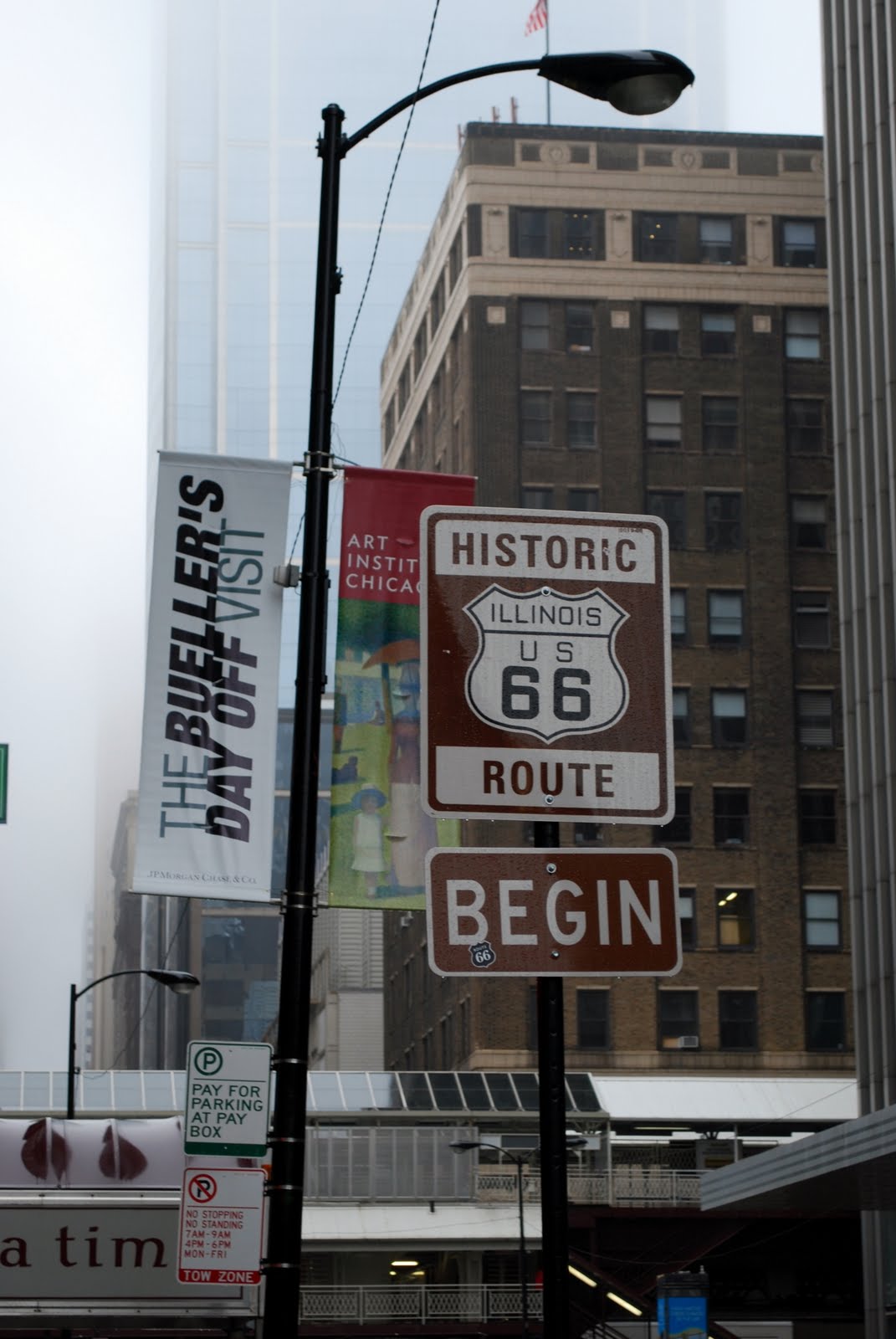
One extra little trivia tidbit:  Across Michigan Ave and Adams Street, directly across from the Art Institute of Chicago, is a marker for the beginning of the historic and legendary Route 66, which travels a total of 2,448 miles from Chicago, Illinois to Los Angeles, California.

I'm linking to the  weekly "Mosaic Monday" event on Mary's blog Little Red House. Please go over to Mary's blog to see Mary's beautiful photo mosaic and the links of all the blogs participating today!


Bookmark and Share

Ancient Egyptian Art at the Brooklyn Museum


The Brooklyn Museum's collection of ancient Egyptian art, one of the largest and finest in the United States, is renowned throughout the world. The Egyptian collection is exhibited on the Museum’s third floor in the Martha A. and Robert S. Rubin Galleries and in Egypt Reborn. Ancient Near Eastern art is exhibited in the Hagop Kevorkian Gallery.  I have viewed these exhibits many times in my life. First, as a young teenager into adulthood,and then again many times when I brought my own children to the museum. As often as I've seen the Egyptian exhibits, I am never without a sense of wonder and awe at their history and beauty. The museum does a wonderful job rotating objects from the collection archives, so there is always a new surprise to see as well as standard favorites.

(All photos will enlarge to allow for a closer view by clicking on it once, and then click on it again when it re-opens)

A relief of Ramesses II

The museum began acquiring Egyptian antiquities at the beginning of the twentieth century, through purchases, gifts and donations, and archaeological excavations.
.
A photo mosaic of some of the many ancient Egyptian artifacts on display.

The museum collection now comprises a wide variety of material from every period of ancient Egypt’s long history, beginning with the Predynastic Period, about 3500 B.C., to the Coptic and Byzantine eras some four thousand years later. The Brooklyn Museum has also conducted archaeological excavations at the Temple Precinct of the goddess Mut at Karnak since 1976.

A Broad Collar from the Old Kingdom

 8,536 objects in the museum's possession can be viewed on the online collections page at this link.


The goddess Bastet, who was often depicted as a cat.

As a cat fancier, I always look for an example of Bastet when I visit an exhibit of ancient Egyptian art. It is usually easy to find a statue of her on display, as she was a popular goddess.


The Brooklyn Museum’s Mummy Chamber explores how and why mummies were made, as part of the strategies employed by ancient Egyptians in their quest to defeat death

The coffin and mummy of Thothirdes - Late Period, Dynasty 26


The exhibit includes a variety of coffins from different periods and various figurines and amulets buried with the mummy.


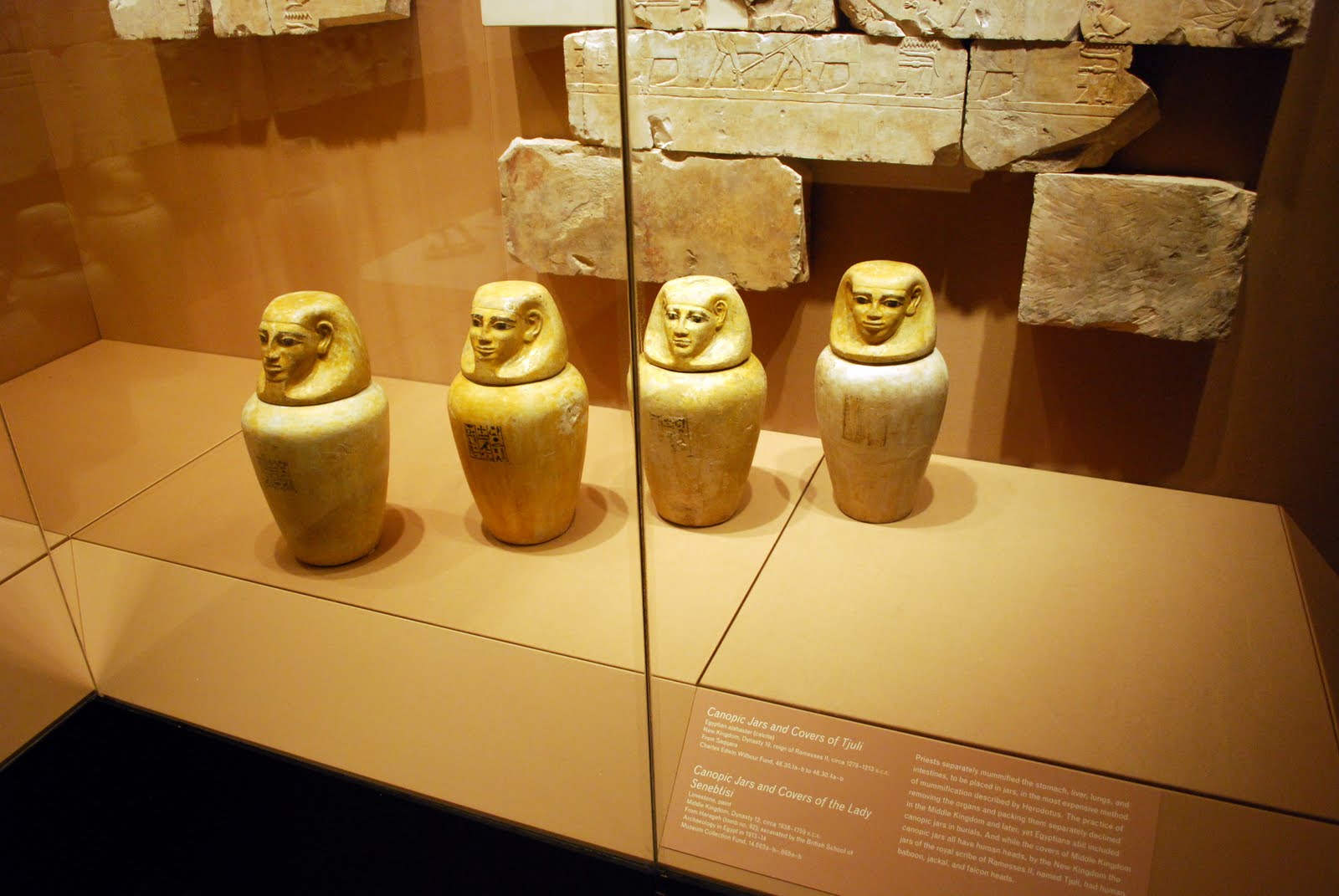
Canopic jars and lids of Tjuli -New Kingdom, Dynasty 19

Canopic jars were intended to hold the separately mummified internal organs. Later, at less extravagant funerals, they were never hollowed out to hold the organs, but were still symbolically included in the tomb.

On display near the mummy chamber was a twenty-five-foot-long "Book of the Dead" papyrus that provided the spells ensuring entrance into the next world and survival there.


A short, but interesting, video about the Book of the Dead of Sobekmose. Acquired in 1937 and never before on pubic display. It has undergone more than two years of conservation.


Inscribed stone slabs, called stelae, were placed in tombs to remember the dead, offer prayer for them, and symbolically provide food, drink and clothing for eternity. Small figurines called shabtis were also placed in tombs, each of which was assigned to “work” in the afterlife.

Animals considered sacred were also mummified and buried. An Ibis mummy coffin on the left and cat mummies and coffins on the right.


Face of Amunhotep II, New Kingdom, Dynasty 18


Akhenaten and His Daughter and Their Offering to the Aten
Late Kingdom, Dynasty18


The Brooklyn Museum also contains selected works of Ancient Near Eastern Art, including Assyrian Reliefs. There are twelve massive carved alabaster panels like the ones seen above, that line the walls of this gallery.  They are but a small sample of the hundreds of such reliefs, all originally brightly painted, that once adorned the vast palace of Ashur-nasir-pal II, one of the greatest kings of ancient Assyria. They were completed in 879 b.c. in what is now Iraq, slightly north of Baghdad.  The story of how these reliefs came to Brooklyn can be read on the museum web site at this link.


I'm sure you can see why the Ancient Egyptian exhibits at the Brooklyn Museum are among my favorites. I feel privileged to have seen so much of the collection over my lifetime living in Brooklyn and it is nice to know that these treasures are being maintained and preserved for future generations.

To see my introduction post about the Brooklyn Museum click here, and to see my post about a few special exhibits I saw at the museum click here.

I am linking this post with Mosaic Monday on Mary's blog at The Little Red House. Click on the link to see links to Mary's beautiful photo mosaic and links to all all the participating blogs.


Bookmark and Share

The Brooklyn Museum -part 2- Special Exhibits


As I described in part one, (click here to read my introduction) the Brooklyn Museum is one of the oldest and largest art museums in the country. It has been modernizing in the past few decades to bring both the building and galleries into the new century. As the museums web site states: "In recent years, the Museum has focused on redesigning its galleries and reinstalling its major collections to make them more accessible to the public. Flowing spaces, vivid wall colors, dramatic graphic elements, and multimedia components feature in many of these reconfigured galleries."


The Museum opened its dramatically redesigned front entrance and new public plaza on April 17, 2004


The sheer-glass entrance pavilion, named the Martha A. and Robert S. Rubin Pavilion and Lobby, provides a dramatic architectural connection between the interior of the building and the exterior surroundings, while bringing natural light into the formerly dark interior. It doubles the lobby space and as you can see in the photo above, it allows space for cultural programs. The first Saturday of each month the Brooklyn Museum stays open late with free family events, which include gallery tours, lectures, arts and crafts, live music, and a dance party. In this way the museum has done much to incorporate itself into the neighborhood by being a welcoming place to visit and not a stuffy institution.


I am a frequent visitor of the Brooklyn Museum and always try to see their special exhibits. Last weekend we went to see Norman Rockwell: Behind the Camera which is located  in the Robert E. Blum Gallery, 1st Floor of the museum.  The last day of the exhibit is April 10, 2011, so we did not want to miss it! The exhibit has been organized by the Norman Rockwell Museum in Stockbridge, Massachusetts, in collaboration with guest curator Ron Schick. Well known in the United States, Rockwell is most famous for the cover illustrations of everyday life scenarios he created for The Saturday Evening Post magazine for more than four decades, and Look Magazine later in his career.

The exhibit stated that from the 1930's, Norman Rockwell used photography as a medium in the production of his art work. He would stage his models to express his ideas, photograph them, then use the photogaphs to copy the people and scenes and bring his illustration ideas to life. As a long time Rockwell admirer this came as a surprise to me, as I always thought his artwork came from his imagination and that he did not use models.

Photography was not allowed in this exhibit, so the following photos are from the museum's web site.


The Norman Rockwell: Behind the Camera exhibit presented the study photographs alongside his paintings, and drawings, to offer a fascinating look at the artist’s working process. For Rockwell's 1950 painting "Shuffleton’s Barbershop" seen on the right above, he said the photographs he took of the actual shop helped him see details, such as the way the light enters the room, that he would have other wised missed if he had done only a rough sketch.


For his 1948 painting entitled The Dugout (above right), Rockwell traveled to Boston with Saturday Evening Post art editor Ken Stuart to photograph fans during a doubleheader between the Boston Braves and the visiting Chicago Cubs at Braves Field. He did additional photos of staged poses as you can see on the left.  This is one of his rare watercolor paintings, as most of his painting were done in oils.


For the 1967 cover of Look Magazine entitled "New Kids in the Neighborhood," Rockwell used his favorite subject, children, to illustrate an article on the changing racial profile of America’s suburbs. The exhibit explained that when Rockwell left The Post for Look magazine in 1964,  he was able to take on issues of social consciousness, such as war, racism, poverty and injustice, and some of his most well know paintings are from that era.


Norman Rockwell (American, 1894–1978). The Tattoo Artist, 1944.
Oil on canvas, Brooklyn Museum, Gift of the artist

It was a fascinating exhibit and a thrill for me to see many more full sized original artworks by Norman Rockwell that up to now I have only been able to appreciate in book form. I have greater appreciation of the amount of time he took into setting up a scene before he painted it, and how much of a perfectionist he was in trying to capture every detail.


Another special exhibit we saw was Tipi: Heritage of the Great Plains  on exhibit February 18 to May 15, 2011, Morris A. and Meyer Schapiro Wing, Cantor Gallery, 5th Floor

Tipi: Heritage of the Great Plains  on the web explains: "...the tipi as the center of Plains culture and social, religious, and creative traditions from the early nineteenth century to the present. The exhibition examines the tipi as an architectural form, an expression of Plains artistic and cultural identity, and an interior space for domestic and ritual use. Tipi features more than 160 objects from the Brooklyn Museum’s collection of Plains material, as well as selected works from other museums; objects by contemporary Plains artists; and three full-size tipis, two with furnished interiors."


A short video about the tipi and its installation.


An informational placard about tipi designs at the exhibit (double click to enlarge)


There were many wonderful artifacts on exhibit. Native American women made most of the family's possessions, and designed and beaded the clothing.  Native American men owned and displayed their medicine bundles and warrior regalia in the tipi, earning the rights to add feathers in war bonnets based on their warrior skills and strengths. I was fascinated by the bear claw necklace made by a Northern Plains Crow artist, circa 1850 as it contains a silver George Washington peace medal dated 1789. (double click on the photo collage above for a closer view).


Last, before leaving the museum, we walked though reOrder: An Architectural Environment by Situ Studio  on exhibit March 4, 2011 to January 15, 2012 in the  Great Hall, 1st Floor.
Situ Studios explains the soft sculptures were a way to show how the museum  has evolved continuously in its 120 year history, constantly reshaping itself and adapting to a unfolding city.

If you are interested to learn more about any of these exhibits the Brooklyn Museum gift shop has books for sale specific to the their topic, among other interesting books, posters, note cards, etc., including my favorite....


(double click on photo to enlarge)

What better gift to get a Brooklyn-ite, past or present, or one who wishes to be ?


There is still more to show about this fascinating museum and my next post will  be about the Brooklyn Museum's collection of ancient Egyptian art, one of the largest and finest in the United States, and world renowned.


Bookmark and Share