Showing posts with label NYC Architectural Gems. Show all posts

The Schenck Houses in the Brooklyn Museum

There are many historical homes still standing in Brooklyn, New York, that date back to early days when it was a Dutch settlement. I've shown the Pieter Claesen Wyckoff House, the Wyckoff Bennett House, the Hendrick I Lott House, and the Lefferts Historic House Museum before on my blog, which all remain on, or near, their original foundations. Now I'd like to show two homes that were dismantled and then reconstructed for display in the Brooklyn Museum to preserve them for all time


The Jan Martense Schenck house is one of the oldest house in the United States. It was built around 1675 in what is now known the Mill Basin/Mill Island neighborhood of Brooklyn, part of the town of Flatlands. Flatlands was one of five towns--Bushwick, Flatbush, Flatlands, Gravesend, and New Utrecht---to become the borough of Brooklyn. Jan Martense Schenck, the man who built this house, arrived in New Netherland in 1650. On December 29, 1675, he purchased the land on which he built the house, along with a half interest in a nearby gristmill.


The house survived through the first half of the 20th century in its original location, but in 1952 the house was at risk of demolition because of development in the area. The Brooklyn Museum arranged to have it dismantled and stored for a decade, until preparations for installation of the house could be made. On April 26, 1964, the house was opened to the public inside the Decorative Arts Gallery.

My photo enlargement  from an informational placard in the museum

If you remember my blog post about the Beautiful Houses in Mill Basin, Brooklyn, you can see how this neighborhood now looks. All of the marsh land has been filled in and the land where the Schenk house stood on is now a school yard.  I grew up in this area of Brooklyn, and while I don't remember the Jan Martense Schenk house being here my older brother and sister do!  They said it was in ruins and covered with vines.

My photo enlargement from an informational placard at the museum

During the 275 years that the house stood in its original location, it underwent many changes to accommodate the needs of new generations. In the museum photo above, the Jan Martense Schenck House is shown with the porch and dormers which were added by about 1825. When reconstructed in the museum it was returned to the original two-room structure.


Part of the exterior clapboard siding has been removed in one section to show a reconstruction of the brick nogging originally used to insulate the house. The museum web site states:  "For many years the house was painted gray. Recent analysis of the exterior paint layers on the original clapboard surviving in the corner at the short end of the building revealed that the house was originally white and then red. Since the interior of the house is interpreted to the first decades of the eighteenth century, we decided that the house might have received its second coat of paint, the red layer, by that time."


None of the original Dutch colonial furniture owned by the Schencks is known to have survived. The curators have assembled the interior-decorations and furniture using objects that would be typical in an interior of a prosperous family of Dutch descent living in colonial English Flatlands. The rooms are viewable behind glass, so unfortunately there is some glare on the glass in my photos.

A linen press.


This informational placard by the second entrance to the house describes the more formal room of the house. (please double click on the photo to enlarge it)


Notice the built in bed boxes with heavy drapes on the fireplace wall on the left side of the room. Staying warm in winter was a challenge, and this was a way to block drafts and utilize radiant heat.


A beautiful wardrobe from the 1600's that would be the type that would have been in a house such as this.
The Schenck family owned the house for three generations, finally selling it in 1784. It was abandoned and in disrepair when rescued by the museum.  How fourtunate that the Brooklyn Museum had the foresight to preserve for all time such a treasure from Brooklyn's past.  It tells the almost forgotten story of the people who were among the first settlers in the United States.

The next house in the exhibit is the house of Nicholas Schenck (1732–1810), the grandson of Jan Martense Schenck,  in what is now the Canarsie section of Brooklyn. It was built about 1775, and installed in the museum in 1929.


The house was heavily remodeled in the early nineteenth century and is therefore installed here as it might have looked about 1830 when Nicholas Schenck, Jr. (1765–1836) lived in it with his family.


A model of what the house looked like when it was on its original location.


Let's enter the Dutch door and enter the house.


The color of the woodwork is based on fragments of paint found under the fireplace mantel and accurately reproduces the original color.

The dining room.

The furnishings of the house, like its architecture, are a mixture of both eighteenth and nineteenth century styles and traditions.

Parlor/living room

Large fireplaces, considered inefficient by 1830, have been closed up and replaced as sources of heat by cast-iron stoves.


The Master bedroom

A child's bedroom.
Although small and rustic, both houses revealed that life was not that much different in the 17th, 18th and 19th century, than modern day life. The kitchen was the heart of the home, and adequate dining accommodations and comfortable bedrooms were important assets to have. 

In addition to the Schenck houses the museum also had other period rooms to view and many decorative items on display.


17th and early 18th century China and silver pieces

17th century glassware

The Brooklyn Museum's collection of decorative arts is considered one of the most important in the country.  It is a fascinating way to look at how life was lived over 300 years ago.

For anyone interested in antiques, American architecture and interior design the Decorative Arts galleries, the American Identities: A New Look gallery and the Luce Visible Storage Study Center in the Brooklyn Museum are not to be missed!


Bookmark and Share

Jane's Carousel, Brooklyn Bridge Park


I recently blogged about the beautiful new Brooklyn Bridge Park, in Brooklyn, New York, which you can read at this link. A brand new edition to the park that opened last week on September 16, 2011, is a wonderful vintage carousel, called Jane's Carousel. If you look closely at the photo above, nestled on the end of a peninsular portion of the park, in front of the Brooklyn Bridge from this perspective, is the acrylic building that houses the carousel. Let's walk closer....


Now you can see how the carousel is situated in the park between the Brooklyn Bridge to the left....


....and the Manhattan Bridge to the right.


The charming Jane's Carousel is housed in a spectacular Pavilion designed by Pritzker Prize winning French architect Jean Nouvel.  According to the website: "Jane's Carousel is a completely restored historic Carousel made by the Philadelphia Toboggan Company (PTC #61) in 1922. It is a classic 3-row machine with 48 exquisitely carved horses, and 2 superb chariots. The wood carvings, often attributed to John Zalar and Frank Carretta, are among the finest of their kind. In addition, the scenery panels, rounding boards, crests, center pole and platform are all original to the Carousel. It was the first Carousel to be placed on the National Register of Historic Places."


"In 1983, as the designated developer of Empire Fulton Ferry State Park, David Walentas had commissioned a Master Plan for the park that called for an historic carousel to be installed. Jane and David Walentas purchased the Carousel at auction on October 21, 1984.

When purchased, the Carousel was in poor condition. Jane Walentas began its restoration at her studio here in Dumbo in 1984. Her initial tasks included making necessary carpentry repairs and hand-scraping away 62 years of "Park Paint" with an X-acto knife to reveal the original 1922 carvings, color palette, and designs. The discoveries were carefully recorded with photographs, color matches, and detailed drawings that guided the repainting of the Carousel. The horses were rendered in faithful detail. The highly decorative carved trappings were newly painted and re-leafed. Missing embellishments such as faceted jewels, small beveled mirrors on the bridles, and delicate pinstriping were restored."


"The Carousel's rounding boards, scenery panels and structural pieces were also repainted, stenciled, and re-leafed. Blackened varnish was removed from original paintings to reveal their true colors. Dozens of old beveled mirrors were reglazed. Mechanical systems were updated with new gears, motor and an electronic controller. Totally rewired, the Carousel now dazzles with 1200 brilliant lights."


The entire story of Jane's Carousel is inscribed on this mirrored monument at the site. The Carousel and the Nouvel commissioned Pavilion are a gift from the Walentas family to the people of the City of New York. It was truly a labor of love by Jane Walentas, and now, after years of restoration and storage, the carousel is finally a wonderful reality!


The day I was there to see it there were lines of happy children waiting to take a ride for a modest price of $2.   I think the children's parents were just as excited to see and ride the carousel.

Who wouldn't love to be a child again, even it is for just a few minutes of a carousel ride?  I know I enjoyed my ride!

You can watch a minute of the carousel ride on my video above or at this link.


You can watch a minute of the ride on my video above or at this link.

The carousel is open everyday except Tuesday from 11 a.m. to 7 p.m. More information about hours and directions can be seen at this link.


I'm linking this post to the following blog events:
Whistlestop Cafe Cooking's "Traveling Tuesday"
"Outdoor Wednesday"
"Alphabe Thursday" -- the letter this week is "W" and I can't think of many more things more Wonderful than a carousel
"Pink Saturday" for all the color pink in the painted horses

Click on the links to go to the events -- many thanks to all the blog hosts!


Bookmark and Share

Ancient Egyptian Art at the Brooklyn Museum


The Brooklyn Museum's collection of ancient Egyptian art, one of the largest and finest in the United States, is renowned throughout the world. The Egyptian collection is exhibited on the Museum’s third floor in the Martha A. and Robert S. Rubin Galleries and in Egypt Reborn. Ancient Near Eastern art is exhibited in the Hagop Kevorkian Gallery.  I have viewed these exhibits many times in my life. First, as a young teenager into adulthood,and then again many times when I brought my own children to the museum. As often as I've seen the Egyptian exhibits, I am never without a sense of wonder and awe at their history and beauty. The museum does a wonderful job rotating objects from the collection archives, so there is always a new surprise to see as well as standard favorites.

(All photos will enlarge to allow for a closer view by clicking on it once, and then click on it again when it re-opens)

A relief of Ramesses II

The museum began acquiring Egyptian antiquities at the beginning of the twentieth century, through purchases, gifts and donations, and archaeological excavations.
.
A photo mosaic of some of the many ancient Egyptian artifacts on display.

The museum collection now comprises a wide variety of material from every period of ancient Egypt’s long history, beginning with the Predynastic Period, about 3500 B.C., to the Coptic and Byzantine eras some four thousand years later. The Brooklyn Museum has also conducted archaeological excavations at the Temple Precinct of the goddess Mut at Karnak since 1976.

A Broad Collar from the Old Kingdom

 8,536 objects in the museum's possession can be viewed on the online collections page at this link.


The goddess Bastet, who was often depicted as a cat.

As a cat fancier, I always look for an example of Bastet when I visit an exhibit of ancient Egyptian art. It is usually easy to find a statue of her on display, as she was a popular goddess.


The Brooklyn Museum’s Mummy Chamber explores how and why mummies were made, as part of the strategies employed by ancient Egyptians in their quest to defeat death

The coffin and mummy of Thothirdes - Late Period, Dynasty 26


The exhibit includes a variety of coffins from different periods and various figurines and amulets buried with the mummy.


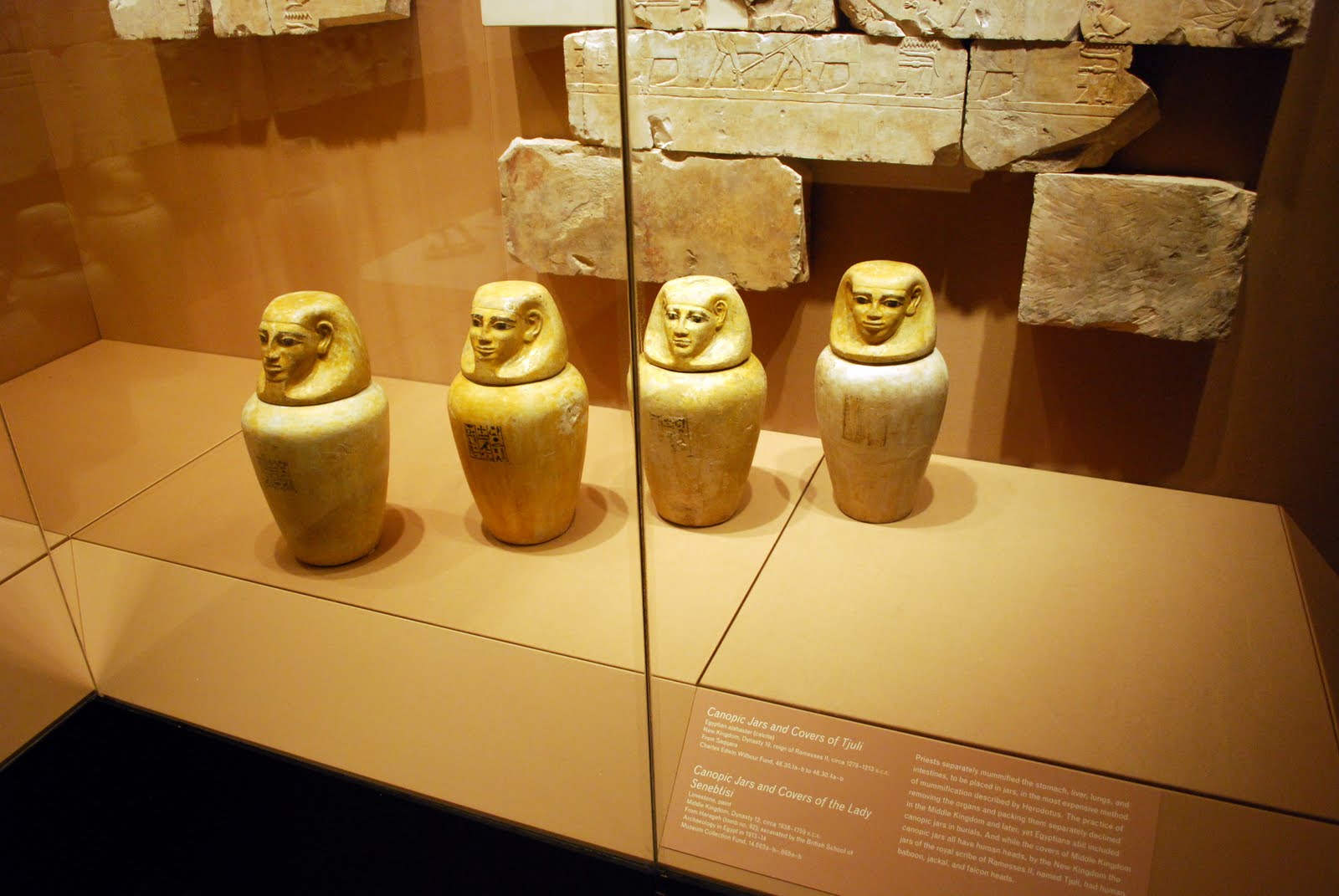
Canopic jars and lids of Tjuli -New Kingdom, Dynasty 19

Canopic jars were intended to hold the separately mummified internal organs. Later, at less extravagant funerals, they were never hollowed out to hold the organs, but were still symbolically included in the tomb.

On display near the mummy chamber was a twenty-five-foot-long "Book of the Dead" papyrus that provided the spells ensuring entrance into the next world and survival there.


A short, but interesting, video about the Book of the Dead of Sobekmose. Acquired in 1937 and never before on pubic display. It has undergone more than two years of conservation.


Inscribed stone slabs, called stelae, were placed in tombs to remember the dead, offer prayer for them, and symbolically provide food, drink and clothing for eternity. Small figurines called shabtis were also placed in tombs, each of which was assigned to “work” in the afterlife.

Animals considered sacred were also mummified and buried. An Ibis mummy coffin on the left and cat mummies and coffins on the right.


Face of Amunhotep II, New Kingdom, Dynasty 18


Akhenaten and His Daughter and Their Offering to the Aten
Late Kingdom, Dynasty18


The Brooklyn Museum also contains selected works of Ancient Near Eastern Art, including Assyrian Reliefs. There are twelve massive carved alabaster panels like the ones seen above, that line the walls of this gallery.  They are but a small sample of the hundreds of such reliefs, all originally brightly painted, that once adorned the vast palace of Ashur-nasir-pal II, one of the greatest kings of ancient Assyria. They were completed in 879 b.c. in what is now Iraq, slightly north of Baghdad.  The story of how these reliefs came to Brooklyn can be read on the museum web site at this link.


I'm sure you can see why the Ancient Egyptian exhibits at the Brooklyn Museum are among my favorites. I feel privileged to have seen so much of the collection over my lifetime living in Brooklyn and it is nice to know that these treasures are being maintained and preserved for future generations.

To see my introduction post about the Brooklyn Museum click here, and to see my post about a few special exhibits I saw at the museum click here.

I am linking this post with Mosaic Monday on Mary's blog at The Little Red House. Click on the link to see links to Mary's beautiful photo mosaic and links to all all the participating blogs.


Bookmark and Share

The Brooklyn Museum -part 2- Special Exhibits


As I described in part one, (click here to read my introduction) the Brooklyn Museum is one of the oldest and largest art museums in the country. It has been modernizing in the past few decades to bring both the building and galleries into the new century. As the museums web site states: "In recent years, the Museum has focused on redesigning its galleries and reinstalling its major collections to make them more accessible to the public. Flowing spaces, vivid wall colors, dramatic graphic elements, and multimedia components feature in many of these reconfigured galleries."


The Museum opened its dramatically redesigned front entrance and new public plaza on April 17, 2004


The sheer-glass entrance pavilion, named the Martha A. and Robert S. Rubin Pavilion and Lobby, provides a dramatic architectural connection between the interior of the building and the exterior surroundings, while bringing natural light into the formerly dark interior. It doubles the lobby space and as you can see in the photo above, it allows space for cultural programs. The first Saturday of each month the Brooklyn Museum stays open late with free family events, which include gallery tours, lectures, arts and crafts, live music, and a dance party. In this way the museum has done much to incorporate itself into the neighborhood by being a welcoming place to visit and not a stuffy institution.


I am a frequent visitor of the Brooklyn Museum and always try to see their special exhibits. Last weekend we went to see Norman Rockwell: Behind the Camera which is located  in the Robert E. Blum Gallery, 1st Floor of the museum.  The last day of the exhibit is April 10, 2011, so we did not want to miss it! The exhibit has been organized by the Norman Rockwell Museum in Stockbridge, Massachusetts, in collaboration with guest curator Ron Schick. Well known in the United States, Rockwell is most famous for the cover illustrations of everyday life scenarios he created for The Saturday Evening Post magazine for more than four decades, and Look Magazine later in his career.

The exhibit stated that from the 1930's, Norman Rockwell used photography as a medium in the production of his art work. He would stage his models to express his ideas, photograph them, then use the photogaphs to copy the people and scenes and bring his illustration ideas to life. As a long time Rockwell admirer this came as a surprise to me, as I always thought his artwork came from his imagination and that he did not use models.

Photography was not allowed in this exhibit, so the following photos are from the museum's web site.


The Norman Rockwell: Behind the Camera exhibit presented the study photographs alongside his paintings, and drawings, to offer a fascinating look at the artist’s working process. For Rockwell's 1950 painting "Shuffleton’s Barbershop" seen on the right above, he said the photographs he took of the actual shop helped him see details, such as the way the light enters the room, that he would have other wised missed if he had done only a rough sketch.


For his 1948 painting entitled The Dugout (above right), Rockwell traveled to Boston with Saturday Evening Post art editor Ken Stuart to photograph fans during a doubleheader between the Boston Braves and the visiting Chicago Cubs at Braves Field. He did additional photos of staged poses as you can see on the left.  This is one of his rare watercolor paintings, as most of his painting were done in oils.


For the 1967 cover of Look Magazine entitled "New Kids in the Neighborhood," Rockwell used his favorite subject, children, to illustrate an article on the changing racial profile of America’s suburbs. The exhibit explained that when Rockwell left The Post for Look magazine in 1964,  he was able to take on issues of social consciousness, such as war, racism, poverty and injustice, and some of his most well know paintings are from that era.


Norman Rockwell (American, 1894–1978). The Tattoo Artist, 1944.
Oil on canvas, Brooklyn Museum, Gift of the artist

It was a fascinating exhibit and a thrill for me to see many more full sized original artworks by Norman Rockwell that up to now I have only been able to appreciate in book form. I have greater appreciation of the amount of time he took into setting up a scene before he painted it, and how much of a perfectionist he was in trying to capture every detail.


Another special exhibit we saw was Tipi: Heritage of the Great Plains  on exhibit February 18 to May 15, 2011, Morris A. and Meyer Schapiro Wing, Cantor Gallery, 5th Floor

Tipi: Heritage of the Great Plains  on the web explains: "...the tipi as the center of Plains culture and social, religious, and creative traditions from the early nineteenth century to the present. The exhibition examines the tipi as an architectural form, an expression of Plains artistic and cultural identity, and an interior space for domestic and ritual use. Tipi features more than 160 objects from the Brooklyn Museum’s collection of Plains material, as well as selected works from other museums; objects by contemporary Plains artists; and three full-size tipis, two with furnished interiors."


A short video about the tipi and its installation.


An informational placard about tipi designs at the exhibit (double click to enlarge)


There were many wonderful artifacts on exhibit. Native American women made most of the family's possessions, and designed and beaded the clothing.  Native American men owned and displayed their medicine bundles and warrior regalia in the tipi, earning the rights to add feathers in war bonnets based on their warrior skills and strengths. I was fascinated by the bear claw necklace made by a Northern Plains Crow artist, circa 1850 as it contains a silver George Washington peace medal dated 1789. (double click on the photo collage above for a closer view).


Last, before leaving the museum, we walked though reOrder: An Architectural Environment by Situ Studio  on exhibit March 4, 2011 to January 15, 2012 in the  Great Hall, 1st Floor.
Situ Studios explains the soft sculptures were a way to show how the museum  has evolved continuously in its 120 year history, constantly reshaping itself and adapting to a unfolding city.

If you are interested to learn more about any of these exhibits the Brooklyn Museum gift shop has books for sale specific to the their topic, among other interesting books, posters, note cards, etc., including my favorite....


(double click on photo to enlarge)

What better gift to get a Brooklyn-ite, past or present, or one who wishes to be ?


There is still more to show about this fascinating museum and my next post will  be about the Brooklyn Museum's collection of ancient Egyptian art, one of the largest and finest in the United States, and world renowned.


Bookmark and Share