Showing posts with label California. Show all posts

A Twilight Walk Along Moonstone Beach


After leaving Paso Robles (to read that post click here) and driving west back to the Pacific Coast Highway, we drove north towards the quaint little community of Cambria, California.  We decided to stop and stay for the night in a motel that was located right across the road from a section of Moonstone Beach. After checking into the motel my husband and I decided to take a sunset stroll along the beach, even though the sky was partially overcast like a woolly blanket stretched along the shoreline.


As the sun dipped below the horizon it struggled to send it's last glowing rays through the cloud bank and the unusual lighting made the ocean and beach appear like a shimmering mirror! It was truly a spectacular sight, and I could see that this area could be a photographer's paradise.

The beach held giant boulders and many smooth black stones that I collected as we walked along the shore.  We stopped in our tracks when we came across large mounds of kelp that had washed ashore in a prior storm.  When we first approached the long tangles of the brown cords (above photo lower right corner) I was reminded of legends of Medusa and other serpent haired monsters. The kelp looked like a living and breathing reptile ready to slither away, but in fact it was specimens of a beneficial brown algae plant called Macrocystis pyrifera that grows along the Pacific coast in large underwater forests. To learn some fascinating facts about the giant kelp forests along the Pacific Coast go to this page: Natural Marine Sanctuaries.


We saw a surfer leaving the beach as the light was slowly disappearing. Moonstone is a world class surfing destination as waves can be as high as 7.5 to 8 feet, and higher, at times.


Our twilight walk along Moonstone Beach left us with many very magical memories.


Back on the road the next morning we headed north along the Pacific Coast Highway to our next planned stop of San Simeon, where we wanted to visit the world famous Hearst Castle.


Can you see the castle high upon the mountain?  On my next post about our California trip along the coast from San Diego to San Francisco I'll take you there!  Meanwhile, come back to my blog on Wednesday for some more "Christmas in New York" city scenes!

I'm linking this post to "Mosaic Monday,"  "Blue Monday" and "Our World Tuesday" blog events.  Many thanks to all the blog hosts!


Bookmark and Share

Eberle and Niner Wineries, Paso Robles, California


After we left the town of San Luis Obispo, California, we took a detour away from the Pacific Coast Highway to go northeast on route Highway 101 to visit a few wineries in Paso Robles Located on the eastern foothills of the Santa Lucia Coastal Mountain Range, Paso Robles is the third largest and fastest growing wine region in California. Scenic country roads lead to more than 180 wineries, where more than 40 premium wine varieties are grown and produced.


Using our AAA Tour Book to chose a winery to visit, we decided on Eberle Winery, recommended as a place of interest because of it's extensive underground wine caves, and as one of the highest award-winning wineries in the U.S. and ranks in the top 10 of gold medal award-winning wineries in the country.


When we approached the Eberle visitor center we were greeted by this bronze statue of a wild boar, which has become sort of a good luck charm for my husband and I.  Why?


It's because we've happened to come across this same fellow quite often in our travels!

The original bronze boar called "Porcellino" was cast by Pietro Tacca in Italy in 1620, and today, the original can be found in the Mercato Nuovo in Florence, Italy. The photo to the top left is my husband touching it's nose in that Italian Market. Legend has it that if you rub the boar's nose and toss a few coins in the fountain it sits on, you will have good luck and if you are a traveler you will return to the same place one day. We have also seen him in Sydney, NSW Autralia, at the Ferrari-Carano Winery in Sonoma, California and now Eberle Winery, Paso Robles.


The Paso Wine web site, had the following information about Winemaker Gary Eberle:

  "A native of Pittsburgh, Pennsylvania, Eberle started his college career in 1962 at Pennsylvania State University. Given a full scholarship, Gary balanced his duties as a defensive lineman for the football team and as a student studying biology. Eberle moved to Louisiana where he did his graduate work in cellular genetics at Louisiana State University (LSU).


During his time at LSU, a professor introduced him to the magical world of food and wine. Tasting a sampling of fine, classified growth Bordeaux from his professor's cellar, Eberle took a keen interest in Cabernet Sauvignon. He began to envision the possibility of creating a wine that would rival those of Bordeaux and soon found himself on an airplane to California.

He arrived at the University of California at Davis, where he met with the chair of the enology department and explained that he wanted to become a winemaker. Impressed with Eberle's credentials, the professor admitted him to the doctoral program without the usual qualifying exam.
During his work at Davis, Eberle realized the untapped potential of the Paso Robles region and decided it was where his winemaking future lay and arrived in 1973. After founding the Estrella River Winery (currently, Meridian Vineyards) Eberle yearned for his own winery focusing on premium red wines. The dream was realized with the release of his first "Eberle" wine, a 1979 Cabernet Sauvignon in 1982."


We enjoyed a few samples of his award winning Cabernet Sauvignon vintages very much!


In 1994, Eberle was seeking additional space for the red wine program and decided to go underground. and created 16,000 square feet of underground caves below the winery to create the perfect place to age their wines.


The caves also contain a 100-seat Wild Boar Room which serves as a romantic and beautiful backdrop for the winery's monthly Guest Chef Dinner Series and other private events.


Before we left the Paso Robles area we stopped at one other relatively new winery, the Niner Wine Estates.


Begun in 2001 by Richard Niner, who had a successful 30 career as a small business investor. He bought  Bootjack Ranch, a 224 acre property on Highway 46 East in Paso Robles and two years later 139 acre Heart Hill Vineyard, which gets its name from a natural oak-tree filled depression on the hillside near the road in the perfect shape of a heart.


The Niner Wine Estates have a state-of-the-art and newly LEED Silver certified gravity flow winery and ta elegant stone barn Hospitality Center on the Heart Hill property. It was interesting to taste their young vintages made using the best of traditional wine making methods and cutting-edge technologies.


 Back on the road, we traveled West on  Route 46, the Green Valley Road.


The rolling mountain scenery of the Santa Lucia Coastal Mountain Range was incredible!

 
We drove again to the coast where we stayed near Cambria for the night. We took a twilight walk on Moonstone beach. More about that in a future post.
 
Linking to "Mosaic Monday" and "Our World Tuesday," and "Alphabe Thursday" blog events. Thank you to all the blog hosts!


Bookmark and Share

Mission San Luis Obispo de Tolosa, California


When my husband and I drove into the town of San Luis Obispo, California, on our trip north along the Pacific Coast Highway from San Diego to San Francisco, we immediately headed over to the Mission San Luis Obsipo de TolosaWe had enjoyed seeing other historical Missions along the coast, and we wanted to also visit this Mission which is often called the "Prince of Missions."  The Mission is located in the middle of downtown San Luis Obispo, at the corner of Monterey and Chorro Streets.


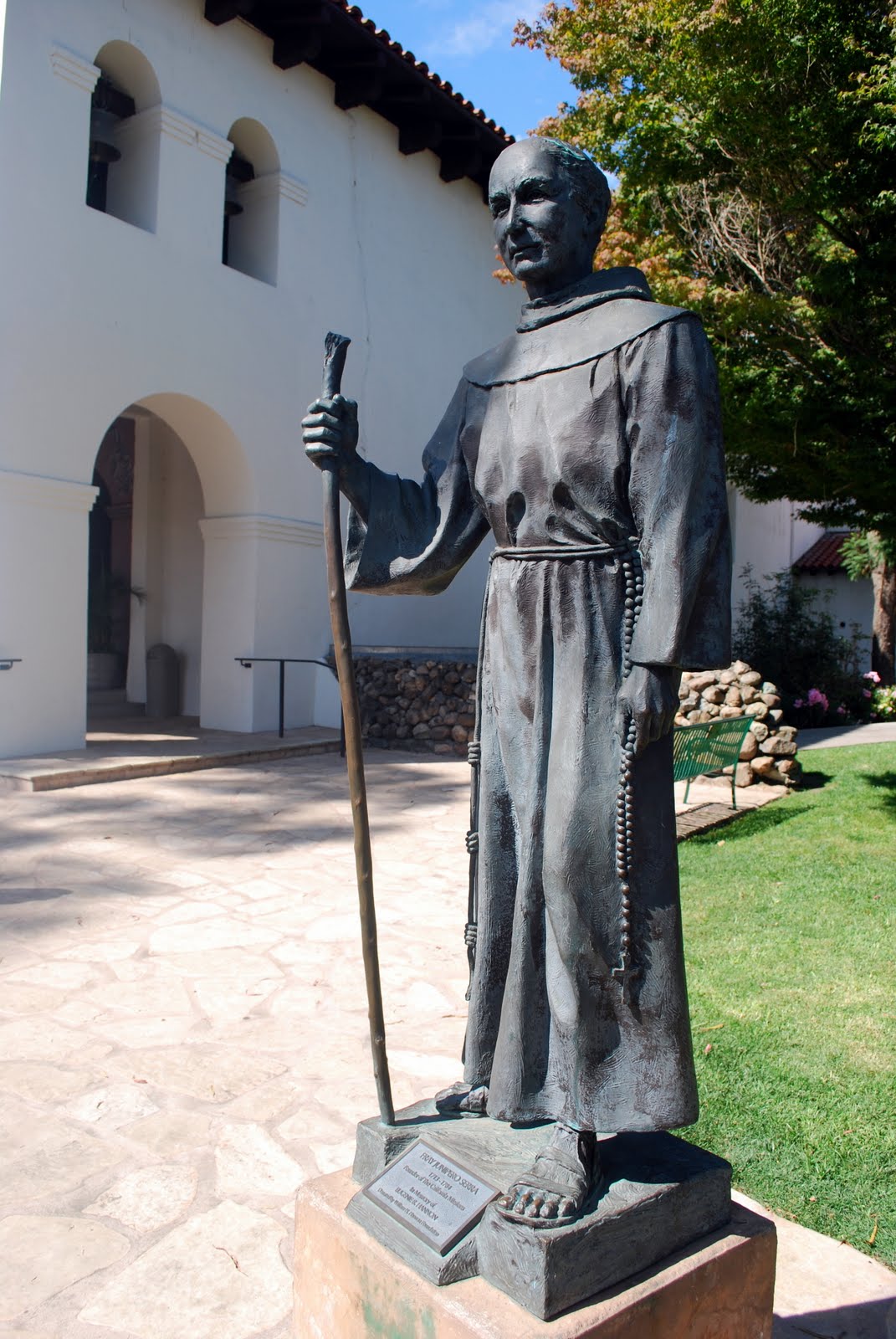
As the fifth California Mission founded by Father Junipero Serra, on Sept. 1, 1772, it was named after Saint Louis, Bishop of Toulouse, France; a 14th century Franciscan. The Mission is located in a spacious valley along the central coast which the Spanish named "La Cañada de los Osos" (Valley of the Bears) when they discovered many grizzly bears living there. 


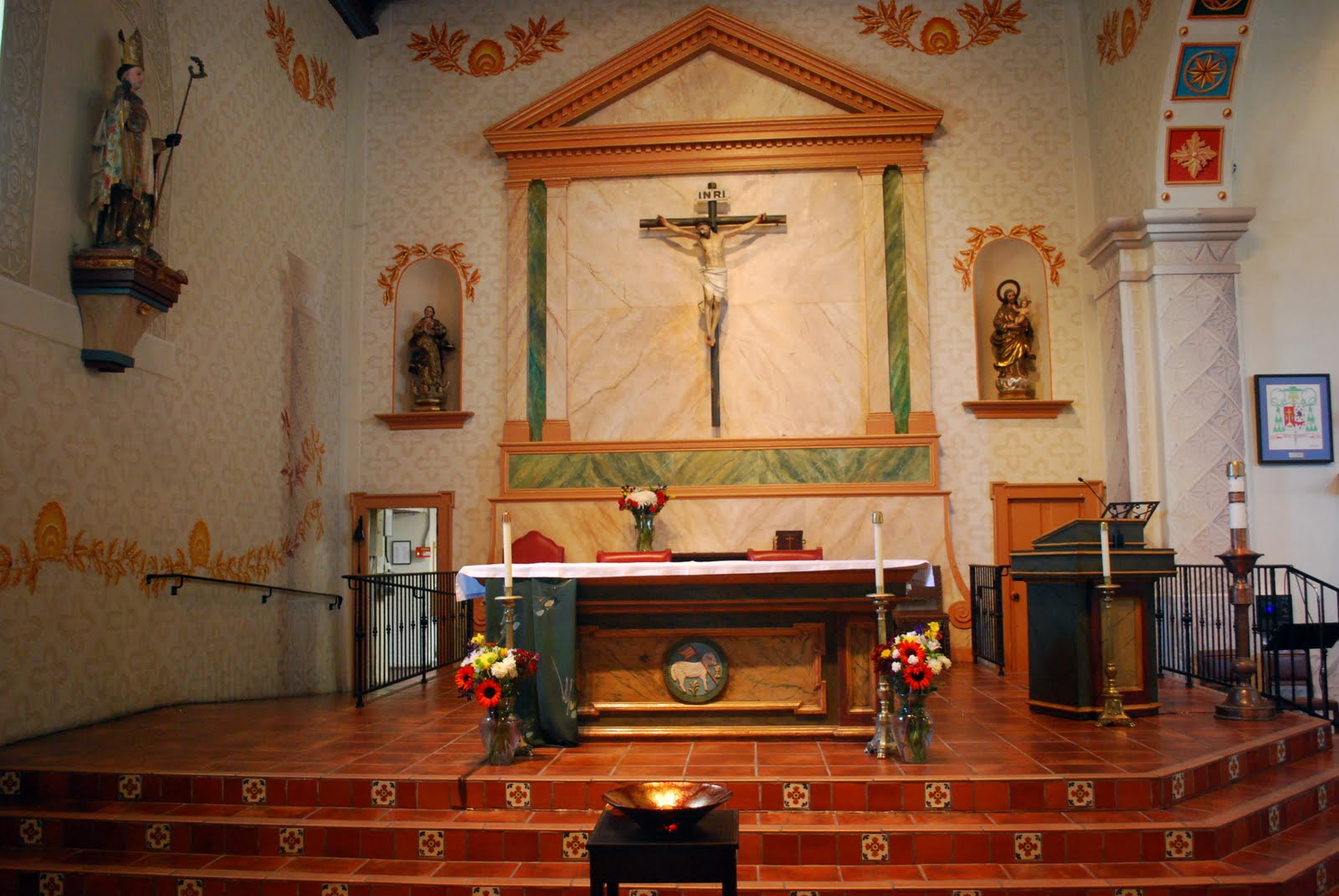
The Mission church is unusual in its design. it has a combination of belfry and vestibule and a long secondary nave to the right of the altar which forms an L-shaped church plan. It is a design not found in any of the other California Missions.


The interior of the Mission was restored back to it's original state in 1934, and it is still used as an active parish church.


The San Luis Obispo de Tolosa Mission has a museum that features a rare collection of early California photographs, authentic Serra relics and specimens of Chumash Indian craftsmanship.


I found this collage of early 1900's photographs of all the 21 California Missions very interesting. Notice how many were in rural locations and now those same Missions have had cities grow up around them. 


The San Luis Obispo de Tolosa Mission grounds were beautiful.  Notice the red tile roofs and the long grape arbor. Under the three bells that were on display (upper left corner of the collage) was a commemorative plaque explaining that the Mission's original bells were lost to time, but these bells were two second and one third generation of bells, called "Joy," "Gloria" and "Sorrow." All of the Mission's bronze bells were usually made in Lima, Peru. Being a bell ringer at the Mission was an honor and it took up to two years to learn the bell ringing craft, as there were complicated bell patterns used to wake the mission inhabitants in the morning, call them to mass and announce the beginning of the siesta. The last two bell ringers at San Luis Obispo did this job for over 60 years each!


The photo on the left of Ah Louis (Wong On), 1840 -1936 - a prominent historical figure who helped to build the town of San Luis Obispo, was in the Mission's museum.  His store is now a historical landmark. The bell located next to the store was donated by Howard Wong Louis, his son, in memory of his father.  Ah Louis was a Chinese American pioneer who founded his store in 1874 to serve as a grocery and merchandise store, employment office, bank post office and pharmacy.  The store was used by the Chinese laborers that were living in the area and working to dig the eight tunnels through the mountains of Cuesta for the Southern Pacific Railroad, from 1884 to 1894.


Our next stop was the third largest wine growing region of California, beautiful Paso Robles, where I was surprised again to be greeted by a statue that I have been fortunate enough to see in Florence, Italy, in Sonoma, California and in Sydney, Australia. Can you guess what it is? If not, I'll be showing it in an upcoming post. It definitely seems to be an unusual "good luck" charm for me!


I'm linking this post to the "Outdoor Wednesday" event on Susan's blog A Southern Daydreamer. Thank you, Susan!


Bookmark and Share

The Madonna Inn--It's All About PINK!


When I am on the road on a vacation I bring my laptop along to stay in touch as much as possible with my favorite blogs and to answer comments. Sometimes my computer time is limited, or Internet connections are slow, so I fall a little behind.  Luckily, I decided to catch up with Susan's Branch's wonderful blog the evening before my husband and I were going to drive up to the San Luis Obsipo. While browsing a few back posts on her blog, I came upon her description of the Madonna Inn on her "We Love Pink" blog post.  What a exceptionally fun place this is for anyone that loves the color pink!


The Madonna Inn, located at 100 Madonna Road, San Luis Obispo, opened for business in 1958. It quickly became a landmark on US Highway 101 in the Central Coast of California.  The Inn was created by Alex Madonna, a successful construction magnate and entrepreneur, with and his wife Phyllis.

The pink begins outside the inn, but it can hardly prepare you....


 ...for all the pink inside!


According to Susan Branch, "Mr. Madonna made the whole thing pink because he thought Mrs. Madonna 'looked good in pink.' "


The banquets are pink....


...the tables and chairs are pink...


 ...parts of the bar are pink


...the carpet and decorations are pink!


Almost everything is pink!


As Susan said in her blog post: "the men’s room downstairs is so interesting, there’s always a line of women waiting to get in to see it!"  No photo here, as I wouldn't want to ruin the surprise, but it is one of the fun, quirky features of the inn you would want to see!


The fun does not end in the inn's lobby, men's room, Copper Cafe, Silver Bar, The Gold Rush Steak House Restaurant, or the attached bakery and pastry shop.  There are also 110 rooms, each decorated with a special theme.  If you go to this link you can see the whimsical names of the suites and a photo of how they are decorated. To continue the all pink theme, the room "Carin" was the one to choose, but there are many rooms in other colors available. One room, called "What's Left," is a patchwork of fabrics, carpet and wallpaper collected from other rooms.  If I had to chose, I thought Yosemite Rock was one of the nicest of the unusual rooms.  Which one would you chose?

Thanks, Susan, for letting us all know about the wonderful Madonna Inn!  I really enjoyed my visit!

I'm linking this post to:

Many thanks to all the blog hosts!


Bookmark and Share

Solvang -- Danish Capital of California


Snuggled in the Santa Ynez Valley in Santa Barbara County, is the charming town of Solvang, which translates a "Sunny Meadows," and is known as the 'Danish Capital of California."  One of my husband's co-workers told us to make an effort to take a detour east from Santa Barbara to visit this town on our trip north to San Francisco along the Pacific Coast Highway. She knew that we'd enjoy its friendly, fairy tale appearance.


Solvang was founded in 1911 on almost 9,000 acres of the Rancho San Carlos de Jonata Mexican land grant, by a group of Danes who traveled west to establish a Danish colony far from the Midwestern winters. There is still a significant Danish population in Solvang, and a number of bakeries, restaurants, and merchants offering a taste of Denmark. The architecture of many of the facades and buildings reflects traditional Danish style.


There was so much to see and do there that I'm sorry we could only spend one afternoon walking around town.


On the top floor of this charming little book store called The Book Loft, located at 1680 Mission Drive, was the Hans Christian Anderson Museum.  Hans Christian Anderson was Denmark's most famous writer.  Although Andersen wrote travel journals, plays, novels, and poetry he is best know for his endearing children's Fairy Tales, which have been translated into more than 100 languages.

The Book Loft also contained a large collection of books about all the Scandinavian countries,  books in the various Scandinavian languages, as well as book in English, and a large selection of children's books.


The museum is devoted to presenting the author's life and works. Displays include models of Andersen's childhood home and of his The Princess and the Pea fairy tale.. The museum also contains hundreds of volumes of Andersen's works, including many illustrated first editions.


We also took some time to visit the Mission of Santa Ines located at 1760 Mission Drive in Solvang.  Santa Ines is the nineteenth of 21 missions established by Franciscan priests from 1769 to 1823.  It was founded on September 17, 1804 by Father Estévan Tapís. Santa Ines is the Spanish version of the name "Saint Agnes." Early English settlers changed the spelling to "Santa Inez" when naming the mountains surrounding the area. Saint Agnes was a Christian who was martyred for her faith in Rome in 304 AD. 


The interior of the church is beautiful and very decoratively painted. The statue of St. Agnes, dating from the 18th Century, is located in a niche above the main altar, and almost appeared to glow, as the soft afternoon light shone upon it.  The mission is still an active parish.


The historical museum at Santa Inés is one of the best in the mission chain. It contains an extensive display of Latin missals and handmade parchment music books, some far older than the mission and many magnificent works of art work, vestments, statuary, documents and mission  artifacts.


As with all the missions we visited on this trip, the gardens and cemetery of Santa Ines were lush and peaceful. We really enjoyed visiting this "Hidden Gem of the Missions," as it is also known.


Before we departed Solvang the next morning we stopped at Olsen's Danish Bakery for a Danish pastry and coffee.  There were so many delicious pastries to chose from that of course we had to have more than one!


We went back on the road, headed towards San Luis Obsipo.   I had to visit a fun location there that I read Susan Branch blog about ... I love Susan's cheerful  blog! I'll be sharing more about that in my blog post for Pink Saturday .. you won't want to miss it!

I'm linking this post to:

Mosaic Monday
Blue Monday
Ruby Tuesday
Our World Tuesday
Rednesday

Many thanks to all the blog hosts!


Bookmark and Share