Showing posts with label Friday Favorite Linky Party. Show all posts

Belfast, Ireland - Markets, Bars and a Cathedral


Congratulations to Prince William and the soon to be Princess Catherine on their marriage today! I wish them much happiness always.  I will be sipping my tea from the James Sadler commemorative mug which I bought on a recent trip to Belfast in Northern Ireland. To see my first posts about this beautiful city click HERE and HERE, or go to the label IRELAND on my blog's right sidebar and click it to see all my prior posts about my visits to the Emerald Isle.


 Belfast has many wonderful shopping venues and one I enjoyed visiting was the Queens Arcade.


There were shops lining both sides of the walkway inside the arcade.  I bought my William and Catherine commemorative mug from a wonderful store called  Little Heart.


Another wonderful shopping venue in Belfast was The King George's Market.  Located on May Street, it is the last surviving Victorian covered market in Belfast. There has been a Friday market on the St. George’s site since 1604. The present St. George’s Market, built 1890-1896, is one of Belfast’s oldest attractions. As well as being home to some of the finest fresh produce, with customers travelling near and far to sample the delights of Friday and Saturday markets, it has become one of the city's most popular places to visit.


My husband and I arrived in Belfast on a Sunday afternoon, and luckily the market was now open for business on Sundays. Our hotel room  was not yet available for check in and the hotel concierge suggested we visit the market while we waited.


There was a wonderful array of goods available for sale, and I wished I had more time to shop!


There were quite a few antique and flea market types stalls in the market and I did manage to chose one goody from this table that I could not resist!  Come back to my blog on Mother's Day on May 8th, and I'll show you the trinket that I bought as a souvenir.


One of the iconic pink and white double decker city buses on the very fashionable shopping area of Donegall Place in the City Centre of Belfast


When we arrived in Belfast we had an incredibly nice taxi driver who was very erudite and friendly and he told us quite a few things we should be sure to see in his city.  One of them was the Crown Bar.


The mosaic tile entrance to the bar.


The Crown Bar is called the most beautiful bar in the world and it is easy to see why once you step inside!

This is its description from it's website:
"Where else would you find a lovely burnished primrose yellow, red and gold ceiling, a floor laid in a myriad of mosaic tiles, brocaded walls ubiquitous highly patterned tiles, vigorous wood carvings throughout, ornate mirrors, wooden columns with Corinthian capitals and feathered motifs in gold?
Painted and etched glass is everywhere you look, vivid in amber and carmine painted shells, fairies, pineapples, fleurs-de-lis and clowns incidentally,the colourful decorative windows fronting the bar were originally intended to shield customers from inquisitive passers-by.

The long Balmoral red granite-topped 'Alter' bar is divided by columns and faced with gaily coloured tiles and a heated foot rest. Look out for the huge casks with their polished brass taps. Save for the inscriptions in English on the Mahogany cabinet behind the bar."

Some more interior shots of the Crown Bar.


Some of the beautiful tiles work on the outside walls of the bar.


While Crown Bar may be the most beautiful bar in Belfast, White's Tavern is the oldest!


Just look at this testimonial above its door! (double click on the photo to enlarge it)

It was not easy to find White's Tavern as it is located in a little alley street, one of many in Belfast.  I walked around for quite awhile until I finally stumbled upon it through the "Winecellar Entry."


This placard on the Winecellar Entry wall describes what the "entries", are, and also the White Tavern location.  I didn't go into the tavern, because my husband was working and I was by myself, but you can see photos of the interior on the tavern's website.  In any event I was determined to see it as I had also visited the oldest pub in Dublin on a prior trip to Ireland, which you can see HERE.


I actually had a good time walking all around Belfast taking photographs of the various pubs, taverns, bars, that I saw! The architecture of many was charming. (double click on the collage to see more detail)


 I also made a point to visit the Belfast Anglican Cathedral of Saint Anne

The Celtic Cross on the exterior of the Belfast Cathedral is the largest Celtic Cross in Ireland.  The three nautical figures called "The Belfast Buoys" are located in a park alongside the cathedral as a tribute to the long maritime history of Belfast.


It was too cloudy the day I visited the cathedral for the interesting large metal spire that passes through the roof of the cathedral to be seen well in my photos, so the photo above is from the cathedral's website. It is called the Spire of Hope.  It is lit at night for all to see.


The interior of the cathedral. Note the lighted section in the roof where the interior point of the Spire of Hope can be seen. The Spire enters the cathedral through this glass platform and standing in the choir visitors can look up the Spire to the heavens.


One of many beautiful stained glass windows inside Belfast Cathedral -- "Blessed are the Peacemakers." 

No visit to Belfast would be complete without learning about the past and present conflict in this city that has been referred to as "The Troubles."  Much reconciliation and healing has occurred in the decades since the worse of the troubles in Belfast, but much is still waiting to be accomplished.  My next blog post will show many photos of the main areas where the conflicts between the Catholics and Protestants in Belfast have taken place and what the current situation is now.

I'm linking this post to "Friday Favorites" event on Sandi's blog The Whistlestop Cafe Cooking and  the "Pink Saturday" event on Beverly's blog "How Sweet the Sound" Thanks for hosting Sandi and Beverly! 

For my Bertolli virtual wine tasting event winner please see my prior post.

Happy weekend to all!


Bookmark and Share

Clinton Street Baking Company and Restaurant


A friend recently celebrated a birthday and I decided to treat her by sharing a breakfast together at the birthplace for our new cookbook obsession: The Clinton Street Baking Company Cookbook. There has been quite a bit of buzz about this small lower East Side restaurant and bakery since husband & wife team, Neil Kleinberg and DeDe Lahman, opened in April 2001. Their mission was to make the best baked goods in the city, hand-mixed in small batches, using quality ingredients such as cage free eggs. Soon large crowds were lining up for breakfast, lunch and dinner. Their cookbook was named one of the best new cookbooks for 2010 by the New York Times (read article at this link). Both the pancakes and the buttermilk biscuits were on our mind as we've heard so much about them.


The Clinton Street Baking Company and Restaurant is located at 4 Clinton Street (between East Houston and Stanton), New York, NY.  The Lower East Side is a trendy yet rough and tumble neighborhood of old time tenement buildings and stores as you can see from a previous post I did about the neighborhood at this link. It may not be where you'd expect to find what was rated as the "best breakfast/brunch" spot by Time Out Magazine or the "best pancakes' by New York Magazine, among other honors which you can read about on this link.


The menu offered many tempting breakfasts, as you can see if you double click on the photo above to enlarge it. I really couldn't get a photo of the inside, as we were seated almost elbow to elbow in the small 32 seat restaurant, and I didn't want to annoy the diners at that table.


None of that mattered when our breakfast was served!  I chose the "Country Breakfast" of three eggs, grilled "cure 81" ham steak hash browns and a buttermilk biscuit. I had especially wanted to try the buttermilk biscuit as they were modeled after the ones that were served in the once legendary seafood restaurant from my youth called Lundy's. That restaurant has been sadly closed for many years so it was nice to taste their wonderful biscuit again.  Martha Stewart has called Neil "The king of buttermilk biscuits," and she is right!  My biscuit was flaky, tender, "melt in the mouth" good! The entire delicious breakfast was so large that the only thing I ate for the rest of the day was a small bowl of soup for supper.
Martha Stewart was kind enough to include the Buttermilk Biscuit recipe on her website, and there is also video to view of her and Neil making the biscuits on her show, which you can see at this link.


My friend had the pancakes served with warm maple butter.  She could have had wild Maine blueberry, banana walnut or chocolate chunk pancakes for the same price, but we both had decided we wanted to try them plain, so as to really see if we liked the basic pancake recipe in the cookbook.

They were served with a raspberry jam on the side which was wonderful!

Neil whips the egg whites separately from the yolks and then folds them slowly into the batter in increments when he makes his pancakes, which makes them extra light and fluffy.
.
Again, he demonstrated cooking his pancakes on the Martha Stewart show and you can see the video and get the pancake recipe at this link.  Over 600 pancake stacks are served a week in this little restaurant so you know that they must be good!


Of course, as a bakery, they also have cake and pies, pastries and muffins, cookies and biscuits for sale which you can see listed at this link. All are available for pick-up only, and most must be ordered 48 hours in advance.


We enjoyed our breakfast celebration so much that I think we'll be making a trip back to the Lower East Side and the Clinton Street Bakery and Restaurant very soon!

I'm linking this post to Jenny Matlock's Alphabe Thursday for this week's letter "Y" and I took the liberty of linking this post for Yummy, Yolks and Yes, those were wonderful biscuits and pancakes!

I'm also linking to Michael Lee's "Foodie Friday" on her blog Designs By Gollum and Sandi's Friday's Favorites on her blog Whistlestop Cafe Cooking.

Thanks to all the hostesses!


Bookmark and Share

The Big Oyster: History on the Half Shell


Are you an oyster lover? Oysters are bivalve mollusks which live and found in fresh or salt water. Filter-feeders, they are notably high in protein, low in calories, and are excellent sources of several minerals, including iron, zinc, calcium and selenium and a good source of vitamin B 12 and vitamin A. Preparation of oysters widely varies, as they can be eaten on the half shell, raw, smoked, boiled, baked, fried, roasted, stewed, canned, pickled, steamed, broiled, or used in a variety of drinks. My favorite way to eat oysters is raw on the half shell served cold on a bed of ice. Sometimes I top each oyster with a little freshly squeezed lemon juice or I add a bit of ground horseradish or cocktail sauce.  I relish them, as they are a delicious taste of the sea!


I just finished reading this excellent book that follows the history of New York City and the renowned oyster beds in the Hudson River estuary.  "Before New York City was the Big Apple, it could have been called the Big Oyster." according to Mark Kurlansky, author of the 2006 book The Big Oyster: History on the Half Shell As Kurlansky states in his book: "For centuries New York was famous for its oysters, which until the early 1900's played such a dominant a role in the city's economy, gastronomy, and ecology that the abundant bivalves were Gotham's most celebrated export, a staple food for the wealthy, the poor, and tourists alike, and the primary natural defense against pollution for the city's congested waterways." 

Kurlansky, who is also the best selling author of "Salt: A World History," and "Cod: A Biography of the Fish That Changed the World," writes in a wonderfully narrative, rambling, factual style that made me feel like I was auditing a university culinary history lecture. He includes historic recipes, maps, drawings and photos among the pages of the book so the reader is totally immersed in oyster lore and facts. He is such a good teacher that I wanted to learn more, and did some of my own research.

Oyster. Digital ID: 480021. New York Public Library
Photo Source: click on photo
Oyster  (1807-1809)

Oysters were extremely plentiful during the early history of New York City, and many were as large as dinner plates, as depicted in the illustration above. The estuary of the lower Hudson had 350 square miles of oyster beds that for centuries fed the Lenape Native Americans, the Dutch settlers, the English, and the Americans after the Revolution. They were a staple of their diet and New York's major export.

Oyster stands in Fulton Market... Digital ID: 806180. New York Public Library
Photo Source: click on photo
Oyster stands in Fulton Market. (1870)

New Yorkers rich and poor were eating them in oyster cellars, saloons, stands, houses, cafes and restaurants.  In some places oysters were sold as an "all you can eat" item for six cents.  In 1860, some 12 million oysters were sold in New York markets; by 1880 the area's oyster beds were producing 700 million a year.

Oyster Houses, South Street an... Digital ID: 482643. New York Public Library
photo source: click on photo
Oyster Houses, South Street and Pike Slip, Manhattan. April 01, 1937 -- notice the piles of discarded oyster shells in front of the buildings.

As the population of New York climbed, the constant discharge of garbage and sewage began to take a toll on the harbor floor. Outbreaks of cholera and typhoid from the apparent consumption of infected oysters began to occur and in 1927 the city's last oyster beds closed and purveyors switched to cleaner oyster sources.

The most common variety of oyster in the United States today is the Blue Point Eastern Oyster, which measures 2 to 5 inches across and can be found from the Gulf of Mexico to Prince Edward Island. They also have regional names: Apalachicola (Florida), Bluepoint (New York), Breton (Louisiana), Chincoteague (Virginia), Malpeque (Canada), and Wellfleet (Cape Cod). Because oysters, or any raw fish or shellfish, may contain harmful bacteria, which mainly comes from unregulated waters, pregnant woman or those with compromised immune systems should avoid eating them.


One of the historical subjects in "The Big Oyster" book that I found fascinating was the history of the Delmonico family and the Delmonico's Restaurant, the first of which was located at 56 Beaver Street in lower Manhattan. The restaurant's website states: "Delmonico's, opened in 1837 as America's first fine dining restaurant, continues to serve the connoisseur of fine American food in its premier location at 56 Beaver Street, the heart of Manhattan's financial district. Birthplace of the Delmonico Steak, Delmonico Potatoes, Eggs Benedict, Lobster Newburg, and Baked Alaska, the original Delmonico's offered unheard of luxury - the availability of private dining rooms, an extensive wine cellar, innovative cuisine, and, above all, warm, personal service."
The first building burned down in a fire and the present building seen in my photo above, replaced it in 1891. Many famous people ate at this establishment, including Queen Victoria and her eldest son, the Prince of Wales, Charles Dickens,Theodore Roosevelt, Mark Twain, Oscar Wilde, Diamond Jim Brady, Lillian Russell, J. P. Morgan, William Makepeace Thackeray.  Samuel F.B. Morse sent the first transatlantic cable from a dining room. An extensive history of the restaurant can be read at the Steak Perfection website.


A collage of photos from the restaurant's web site, which includes a 20 ounce prime rib-eye steak, grilled to perfection and topped with herbed butter, which is a signature dish that's the gold standard for all steak houses try to achieve.  The restaurant has changed ownership many time over the years, but it still retains the Delmonic's name and many of the signature dishes that have been a part of the Delmonico tradition since its early days.


A video on how to open a live oyster by a chef instructor, Gerard Viverito, of the Culinary Institute in New Hyde Park, New York.

For a truly elegant way to serve oysters try a mignonette sauce and caviar. The following recipe is adapted from The Culinary Institute of America's "Garde Manger, The Art and Craft of the Cold Kitchen."

Oysters with Mignonette Sauce and Caviar

Makes 2 servings

•2 tablespoons minced shallots
•6 tablespoons chopped chives
•1/3 cup champagne vinegar
•3 tablespoons cracked black pepper
•12 to 18 oysters
•1/2 ounce osetra caviar

1. In a medium sized bowl, combine the shallots, chives, vinegar, and pepper and reserve.
2. Shuck the oysters, loosen muscle from bottom shell, then remove oyster with top shell.
3. Place the oysters in their shells on a bed of crushed ice. Top each with mignonette sauce and a dollop of caviar.

No matter if you are an oyster connoisseur, or a history buff, you will find reading "The Big Oyster: History on the Half Shell" both entertaining and delicious!

I'm linking this post to  Jenny Matlock's Alphabe Thursday for this week's letter "S" for oyster's found in the Sea that taste so good Slurped right off the Shell!
I'm also linking to Michael Lee's "Foodie Friday" on her blog Designs By Gollum and Sandi's Friday's Favorites on her blog Whistlestop Cafe Cooking.
This is also an Edible Book Review inspired by Jain at Food for Thought, a delicious blog for readers with an appetite for the written word.  I will also be linking with Mary of the blog Home Is Where The Boat Is  who is hosting a "Cook Your Book and Join In The Fun" event March 1st -- I give The Big Oyster: History on the Half Shell **** for "good read!"

 Thank you all for your inspiration! Please visit all these wonderful blogs and join in on all the fun!


I will be choosing the winner of my "One World, One Heart" give away tomorrow, February 17, 2011.  Please check the original post on this link to see the winner. Thank you to all who entered!  It was so nice meeting so many wonderfully creative bloggers!


Bookmark and Share

Letters To Juliet for Valentine's Day


The somewhat grainy photo on the left is of a time long ago when I was not yet twenty years old, on a wonderful school trip to Italy. I am standing on the veranda of the Palazzo Borromeo on Isola Bella. I always had a bit of wanderlust in my blood even though my family rarely left our home in Brooklyn, New York. About the only place we visited regularly was my maternal grandmother's home in rural Pennsylvania, and I'm sure my love for the country and old fashioned farm life came from those wonderful visits. But the desire to travel always burned bright in me and when I heard that my high school sponsored a two week trip to Italy every spring, I worked very hard to save my earnings from various part time jobs to be able to go in my senior year. This was the trip of a lifetime, and now that I am in my silver years I look back fondly at the experience, ever happy that I took the chance to go!

I bought many postcards on that trip as I was afraid my little Kodak instamatic camera would not capture the beauty before me. The photo on the right is showing Isola Bella, one of the Borromean Islands of Lake Maggiore in the Piedmont region of northern Italy. In 1632 Carlo III of the influential House of Borromeo began the construction of a palazzo dedicated to his wife, Isabella D'Adda, from whom the island takes its name.  Isn't that a testimony to love? The island achieved its highest level of social success during the period of Gilberto Borremeo (1751–1837) when guests included Napoleaon and his wife Josephine.

Our tour of Italy began and ended in Milan, and we traveled to sixteen cities in two weeks. After touring Milan we traveled to Stressa in Piedmont, over the border at Ponte Tresa for a day in Switzerland to visit the Italian speaking section of Lugano, and then back again to Italy to tour Lake Como. We then went on towards Venice, stopping along the way in Verona, in the Veneto region of north east Italy.  There we saw an ancient amphitheatre built by the Romans, and this famous and romantic sight...


My circa 1970's photo of the legendary Juliet's balcony at Villa Capuleti in Verona is on the left. The balcony scene in Shakespeare's play Romeo and Juliet, which was about young star crossed lovers of long ago whose tragic deaths are said to have ended a violent and long-standing war between two powerful families, supposedly took place here. The first accounts of Romeo and Juliet was in a "novella" by Luigi Da Porto (1531). He was a captain in the service of the Venetian Republic and he claimed that one of his bowmen, named Pellegrino da Verona, told him the true story of two unfortunate young lovers who had lived at the beginning of the 14th century and belonged to two rival families, the Capulets and the Montagues. This novel inspired a lot of other European writers, until it reached the peak of artistic expression in Shakespeare's "Romeo and Juliet," written in 1596.  A clearer postcard view of the same balcony from the 1970's is on the right. If you were to visit this courtyard today you would find a bronze statue of Juliet, large amounts of tourists, informational signs about the legend and many letters and notes attached to the walls from present day star crossed lovers who are asking Juliet for help. The letters are typically answered by the "secretaries of Juliet," who are volunteers from Verona who for more than 70 years have collected the notes and the letters that arrive in the mail by the thousands, and then write back to every single letter writer who gives an address!

An oil painting of Romeo and Juliet
 Ford Maddox Brown 1821 - 1893
 Delaware Art Museum

Which leads me to this charming movie, and the subject of this blog post: "Letters To Juliet"  Please take a few moments to watch the movie trailer below:


Although I found the movie somewhat contrived and sappily sweet, it is certainly a fun movie to watch for Valentine's Day. You can easily find it on DVD.  It's a delightful movie to watch for all its beautiful scenes of Italy and also to see the stately beauty of Vanessa Redgrave.  If I can age as gracefully as she has, I would be a deliriously happy woman!

In reality a group of about 15 secretaries, the Club di Giulietta (link is to the English version), divides up according to their languages and romantic problems, the more than 5,000 written letters that also pour by mail into Verona, and answer them. Secretaries have been doing this since about 1940, when one of the caretakers of Juliet's house and tomb began answering the notes and letters that had been piling up for years. They even award a "Cara Giulietta" ("Dear Juliet") prize on Valentine´s Day to the most compelling letters received during the previous year.


You can also look for a copy of the Letters to Juliet book, which has nothing to do with the movie, but is also a charming story about these letters and the Juliet Club volunteers.

Roses in the Rose garden of the Brooklyn Botanical Garden

I'm sure you'd like to know if I left a letter for Juliet when I visited Verona so many years ago? Thankfully I didn't have to, as I met my future native born Italian husband two years later. But I did imagine him, and asked  "the powers that be" to help me meet him at another very special and magical place.....and it wasn't even in Italy.....but that, as they say, is a story for a future blog post!


Happy Valentine's Day!

I'm linking this post to "Coast to Coast, The Colors" of Love at Candy's The Little Round Table,  "Friday's Favorite Linky Party" on Sandi's blog Whistlestop Cafe Cooking, "Pink Saturday" on Beverly's blog "How Sweet the Sound," Laurie's "Valentine Party" on her blog Chatting and Bargain Hunting with Laurie, Mary's "Mosaic Monday" on her blog Dear Little Red House, and "Rednesday" at Sue's It's a Very Cherry World. Thank you all for your hospitality!


Bookmark and Share

Arthur Avenue in the Bronx is Seafood Heaven!


New York City is composed of a multitude of different ethnicities, often living for many generations condensed into their own small neighborhood in each borough of the city.  Most New Yorkers and tourists know of the "Little Italy" neighborhood in Manhattan, where the famous Feast of San Gennaro is held each year, and Bensonhurst in Brooklyn, whose Italian ethnic markets I've blogged about previously, and there are also predominate Italian neighborhoods in both Queens and Staten Island.
Arthur Avenue in the Belmont neighborhood of the Bronx is synonymous with another "Little Italy" area which stretches across East 187th Street from Arthur Avenue to Prospect Avenue, and is similarly lined with delis, bakeries, cafes, and various Italian merchants and restaurants. (All photos will enlarge when clicked on once, and then clicked on again when they open on a new page)


The Provolone cheese balls were wearing Santa Hats in this Arthur Ave store window!

According to the Arthur Ave website: "Among the notables born and raised here are actor Chazz Palminteri, author Don DiLillo and rock star Dion DiMucci, whose group, Dion and the Belmonts, is named after a local street (Belmont Avenue). Joe Pesci began his acting career after being discovered by Robert DeNiro at a local neighborhood restaurant, where Pesci worked as the maitre'd."


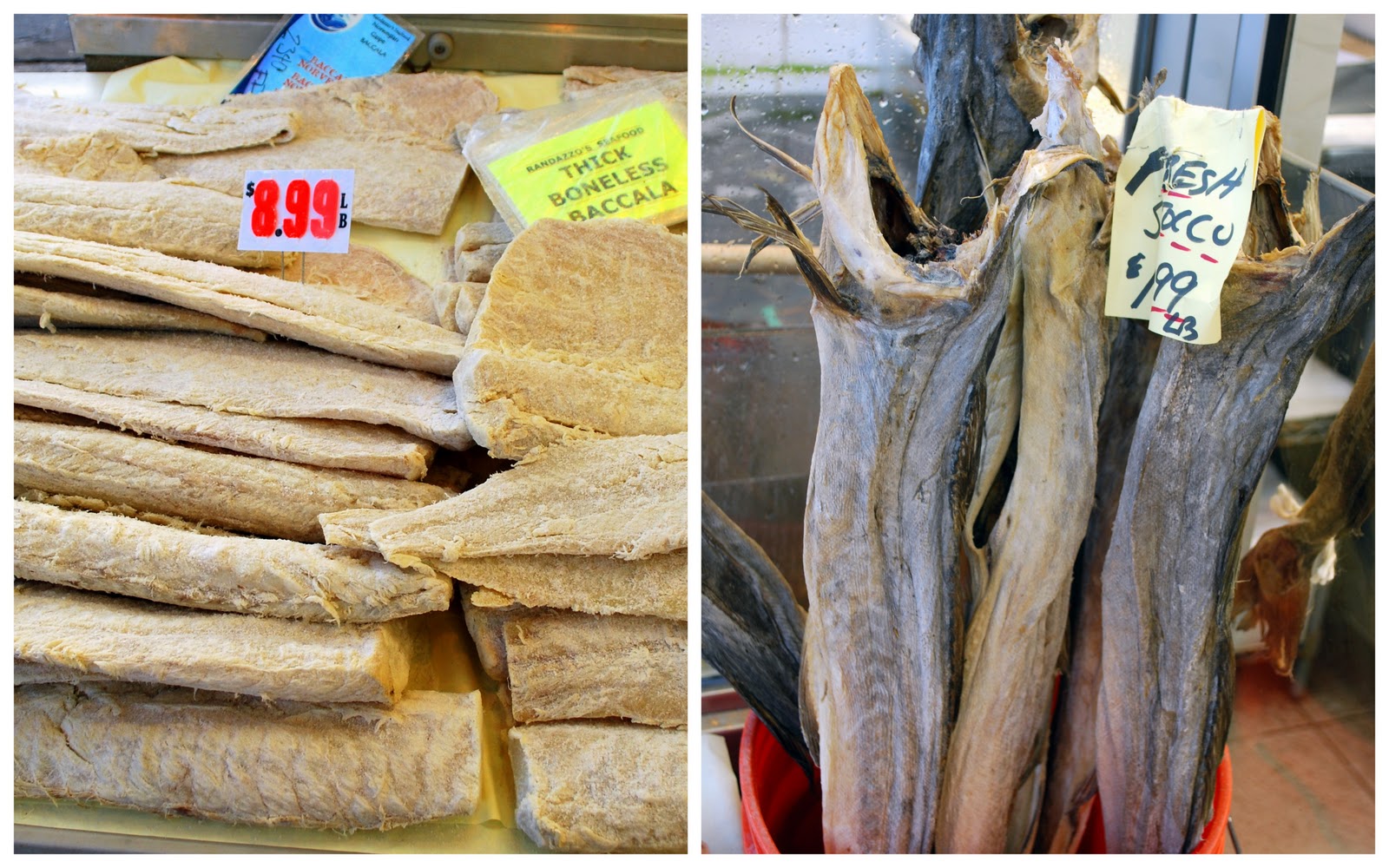
My husband was born in Southern Italy, in the Provence of Reggio Calabria, and it is customary every Christmas Eve for a Southern Italian to have a "Feast of the Seven Fishes."  One of his favorite fishes to eat is baccala, a cod fish that has been dried and preserved by salting (photo above on the left), or stocco, an air dried cod (photo above on the right.)  Obviously these type of fish are not readily available in most markets so a visit to an Italian neighborhood is a must before Christmas, to buy this fish and to begin to rehydrate it for cooking at home. We made the trip from Brooklyn up to the Bronx to attend the Holiday Train Show at the New York Botanical Garden, which is in close proximity to Arthur Ave and decided to shop for our baccala while we were there.


We stopped at Randazzo's Seafood located at 2327 Arthur Avenue. A part of Arthur Avenue for over eighty years, a third generation of the Randazzo family runs the store.


Their website states that fresh fish comes in daily, many varieties imported from Italy!


They specialize in fresh clams, mussels, live crabs and lobsters, and they had a clam bar outside where you could stop and have a half or whole dozen oysters or clams shucked, to be eaten right then and there!


The array of fish inside for sale was dazzling!


There was every type of fish and shellfish imaginable!


One visit to this store and I could buy every fish I needed and more to make my Feast of the Seven Fishes! We did indeed buy a nice big piece of baccala and I prepared it two ways after I reconstituted it by soaking it in many changes of water. I fried the thick portions and I made the thin portions "Florentine style" which you can see in this post.


This is some of the seafood I prepared for Christmas Eve. Top left in the photo collage above is a platter of crab cakes, fried shrimp, and fried baccala, top right is baccala Florentine, bottom left are baked lobster tails oreganata, and bottom right is stuffed salmon.  We all love seafood in our family, so this is one of our favorite holiday meals!


There are many other wonderful seafood markets along Arthur Avenue.


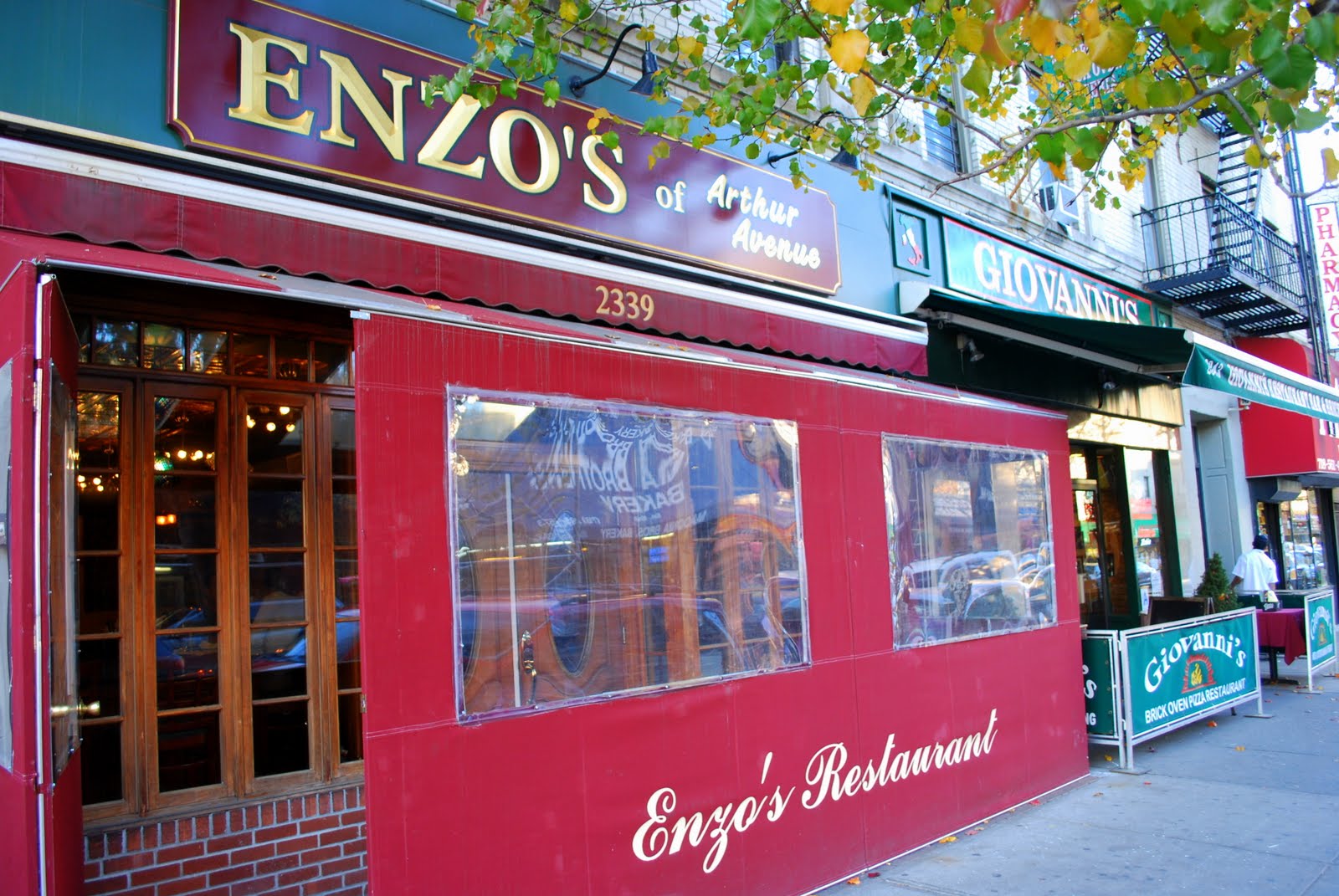
There are also many wonderful restaurants that serve seafood...


...and all kinds of Italian cuisine specialties!

I have much more to show, so part two of Arthur Ave will be coming up soon!


I'm adding this post to Michael's blog Designs by Gollum "Foodie Friday," Sandi of The Whistlestop Cafe Cooking "Friday Favorites Linky Party, Laurie of Bargain Hunting and Chatting with Laurie for "A Few of my Favorite Things-Saturday," and Beverly of How Sweet the Sound for "Pink Sunday" as there were a few pink shrimp and lobsters among my photos! Thank you to all the gracious hostesses of these events for allowing us to share in all the fun!


Bookmark and Share