Showing posts with label Ireland. Show all posts

100th Anniversary of the Sinking of the Titanic


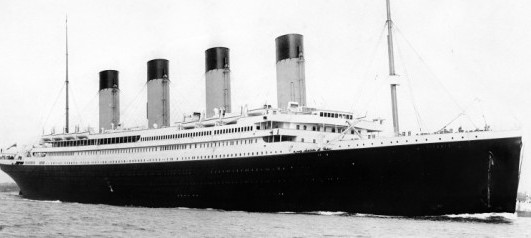
At 11.40 PM on Sunday April 14th, 1912 the Titanic, bound from Southampton, England to New York, struck an iceberg just off the coast of Newfoundland and became fully submerged within three hours, before dropping to the bottom of the Atlantic Ocean at 2:20 AM on April 15, 1912.  The sinking of the vessel, which belonged to the White Star Line shipping company, caused the death of 1,514 men, women and children, making it one of the deadliest peacetime maritime disasters in history.


Passengers on board the ship included some of the world's wealthiest people, including millionaires such as John Jacob Astor IV, Benjamin Guggenheim and Isidor Straus, and thousands of immigrants seeking a new life in America.  There have been many stories over the years recounting why the ship struck the iceberg and why two-thirds of the passengers and crew lost their lives.   Was it from faulty construction or the lack of lifeboats?  Was it from the absence of binoculars in the crow's nest during night watch or from the shortcomings of the radio operator?  The mystery will probably never be sufficiently solved.


When I visited Belfast, Northern Ireland, last year I saw the iconic Harland and Wolff shipbuilding gantry cranes nicknamed "Samson and Goliath" that have become city landmarks. This Belfast shipyard has built many ships; among the more famous are the White Star line trio of the Olympic, Titanic and Britannic.


The city of Belfast was constructing a large six story exploration center called Titanic Belfast at the time of my visit last April, which officially opened on March 31, 2012 to honor the legacy of the 100th anniversary of the launch and fateful first voyage of the RMS Titanic.


Built very close to the site where the Titanic was built, the Titanic Experience enables visitors to:

 "Immerse yourself in the amazing story of Belfast in the 1900s, take a spin in the Shipyard Ride, experience life on board and learn about Titanic’s maiden voyage, her tragic sinking, the many stories of human endeavour, and the technology and science that finally found her, and helped to solve some of the many mysteries surrounding that fateful night in 1912."


I toured the beautiful Belfast City Hall during my visit and learned there was one link between Belfast and Harland and Wolff’s most well-known ship that is a bit more obscure. It was the Lord Mayor’s dressing room in Belfast City Hall which you can learn about in this video:


"Dianne Leeman, Tour Service Operator in the City Hall, explains, ‘Viscount William Pirrie was Lord Mayor of the city as well as being director of Harland and Wolff for many years, including those when the Titanic was built. So he utilised his craftsmen down at the shipyards to work on the two big projects, the City Hall and the Titanic."


This is the replica of the Titanic in Belfast City Hall that she speaks about in the video as well as ....


... the brass memorial plaque that was taken down to the hull of the sunken Titanic and left on the bridge for a few moments and then returned to Belfast for display in memory of those lost with the ship.


There were also interesting placards outside Belfast City Hall that explained the role Belfast had in the planning, construction and launch of the Titanic.


Outside on the eastern garden grounds of Belfast City Hall stands the Titanic Memorial, dedicated to the Belfast men who were lost on board RMS Titanic. Designed by the acclaimed sculptor Thomas Brock, the memorial depicts the female figure of Thane, who looks down upon two sea nymphs as they rise from the waves with the body of a drowned seaman in their arms. Originally unveiled on June 26, 1920 in Donegall Square North, it was moved to its current location on March 24, 1960
The names of the dead include the ship's designer Thomas Andrews and doctor John Simpson.

Of course the Titanic's final destination was to be New York, before it hit an iceberg in the North Atlantic and sunk, so there is also a Titanic Memorial in New York City 


It is a 60-foot-tall lighthouse built, due in part to the instigation of Margaret Brown (better known as the "Unsinkable Molly Brown), to remember the people who died on the RMS Titanic on April 15, 1912.  The lighthouse was originally erected by public subscription in 1913, and stood above the East River on the roof of the old Seamen's Church Institute of New York and New Jersey at the corner of South Street and Coenties Slip.


You can see the lighthouse on top of the Seaman's Institute building in the photo above.   From 1913 to 1967 the time ball at the top of the lighthouse would drop down the pole to signal twelve noon to the ships in the harbor. This time ball mechanism was activated by a telegraphic signal, from the Naval Observatory in Washington D.C. In July 1968 the Seamen's Church Institute moved to its present quarters at 15 State Street and this building was demolished. That year, the Titanic Memorial Lighthouse was donated by the Kaiser-Nelson Steel and Salvage Corporation to the South Street Seaport Museum. It was erected at the entrance to the museum complex, on the corner of Fulton and Pearl Streets, in May 1976.


I'd love to tell you a little more about Margaret Brown, of the "Unsinkable Molly Brown" legend, who was aboard the Titanic on its maiden voyage in my next post.


I'm linking with the following blog events:


Thank you to all the blog hosts!


Bookmark and Share

Saint Patrick's Grave in Downpatrick, Northern Ireland

My photo of a Saint Patrick statue
 Holy Cross Cemetery, Brooklyn, New York

When everyone celebrates Saint Patrick's Day around the world on March 17th with parades, leprechauns, shamrocks, corned beef and cabbage, and green beer, etc, it can be easy to forget that this day is the feast day of a real man who, for the most part, lived and died in Northern Ireland around the early part of the 5th century, and converted the then pagan Irish natives to Christianity.


My photo of a St. Patrick Statue 
 Church of St. Joseph
Brooklyn, New York

When Saint Patrick was around 14 years old he was kidnapped from his Scottish homeland by Irish raiders and sold into slavery in Ireland.  He was forced to work as a shepherd for six years, living under harsh conditions and suffering hunger and cold. Patrick turned to God for help as he wrote:

"The love of God and his fear grew in me more and more, as did the faith, and my soul was roused, so that, in a single day, I have said as many as a hundred prayers and in the night, nearly the same." "I prayed in the woods and on the mountain, even before dawn. I felt no hurt from the snow or ice or rain."

Saint Patrick
Holy Cross Cemetery, Brooklyn, New York

He eventually escaped through divine intervention and returned to his homeland, where he entered the priesthood and rose to the position of Bishop.  Patrick had many visions of the people of Ireland begging him to return:

"I saw a man coming, as it were from Ireland. His name was Victoricus, and he carried many letters, and he gave me one of them. I read the heading: "The Voice of the Irish". As I began the letter, I imagined in that moment that I heard the voice of those very people who were near the wood of Foclut, which is beside the western sea—and they cried out, as with one voice: "We appeal to you, holy servant boy, to come and walk among us."


St. Patrick,  Church of St. Joseph, Brooklyn, New York

Legend has it that Saint Patrick used a three leaf shamrock to explain the Holy Trinity to the Irish people, using its three leaves to symbolize the concept of three divine persons of God: the Father, Son and Holy Spirit. He left a particularly strong impression in Ulster, especially in the Downpatrick area, although at the time of his death he had not yet converted the whole island and was still subject to persecution. After nearly thirty years of missionary work he died on March 17, 461, and according to tradition, was buried at Downpatrick.


I was very fortunate last year to be able to visit Downpatrick one of Ireland's most ancient and historic towns, when I was on a trip to Belfast, Northern Ireland last April of 2011. You can read about that trip, and others I've made to Ireland, if you scroll through my Ireland label here.


In Downpatrick I visited The Saint Patrick Centre, located at 53A Market Street, Downpatrick, County Down.


The Centre is an exciting interpretative exhibition which tells the fascinating story of Ireland's Patron Saint through Patrick's own words, as you can see in the photo mosaic above. A series of interactive displays allow visitors to explore how Patrick's legacy developed in early Christian times and enjoy the fabulous artwork and metalwork which was produced during this Golden Age.


The highlight of my visit to Downpatrick was in the grave yard of Down Cathedral, which is part of the Church of Ireland. It stands on the site of a Benedictine Monastery, built in 1183. Unfortunately, the church was not open on my visit, but interior photo links can be found at the bottom of this web page.


Slightly behind, and to the side of the church, on Cathedral Hill, is the graveyard.


There, on the crest of a hill overlooking the town of Downpatrick, lies the remains of Saint Patrick in a grave located under this slab of granite from the nearby Mourne Mountains.


On top of his marker were a few dried out bouquets of flowers that may have been laid there a month before, on his feast day last year.


I read the inscribed placard that says the remains of Saint Brigid and Saint Columba are also interred in this cemetery.


Tears came to my eyes as I touched the stone.


I was so touched and grateful to see the final resting place of the Saint whose name I bear, and in the country of some of my ancestors. This was one of the most memorable and spiritual sights of all I've seen in Ireland!


I'm linking  this post to the following upcoming blog events:

Pink Saturday  (Green for St. Patrick's Day!)

and


Thank you to all the blog hosts!

Have a very


Bookmark and Share


The Causeway Coastal Route, Northern Ireland, Part 2


As I continued on a bus tour of the Causeway Coastal Route in Northern Ireland (part one can be read here) we left the Glens and entered the North Antrim Coast area. (All photos will enlarge if double clicked on)


The bus stopped at the Old Bushmills Distillery in the town of Bushmill.  Here we took a short tour and sampled some of the very smooth Irish whiskey. The word "whiskey" comes from the Gaelic language words "uisce beatha," which means "water of life." The Old Bushmills plant is the oldest distillery in the world! It's "Grant to Distill" was officially given in 1608, but it is suspected that whiskey was made here for at least 200 years before that!  The Old Bushmills brand is a blend from a single malt and a single grain.  I had visited the distillery once before with my husband --you can see that visit on this link.  I did not partake in the sampling of any whiskey this time as I wanted to keep my senses for what was ahead.


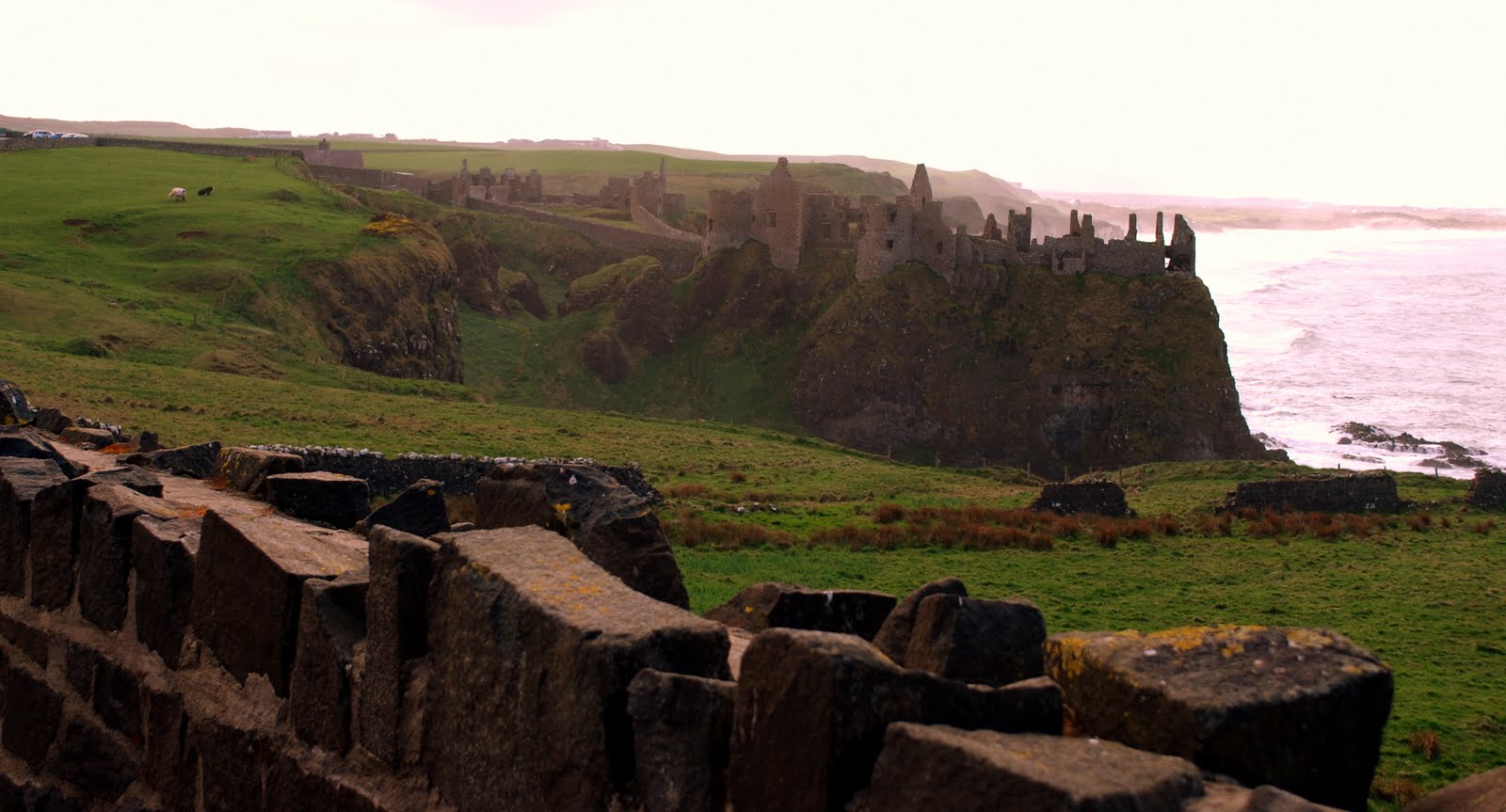
We stopped again for a view of the mystical looking ruins of Dunluce Castle. The castle stands on a 100 ft high basalt cliff with a sea cave running underneath it.


Dunluce Castle has a rich and varied history, connected with such names as Richard de Burgh, Sorley Boy MacDonnell, and Sir John Perrott, running up to its last occupant, Randall MacDonnell, who was the second Earl of Antrim.

Legend has it that in the early 1600's the castle's kitchen broke off and plunged down into the sea.  The kitchen staff plummeted to their death upon that fateful day and thereafter the castle's countess refused to live there any longer and  moved to a residence inland.  After the mid 1700s the deserted castle fell into ruins.


Dunluce Castle was fought over many times in it's past and it is wrapped in myths and legends, one of which is that mermaids lived in caves at its base. On a clear day you can look over the expanse of ocean and see County Donegal. The castle was given to the Northern Ireland government by the Earl of Antrim in 1928, to be preserved as a National Monument.


Now we entered the Causeway Coastline where the sea was rough and misty the day we visited. 


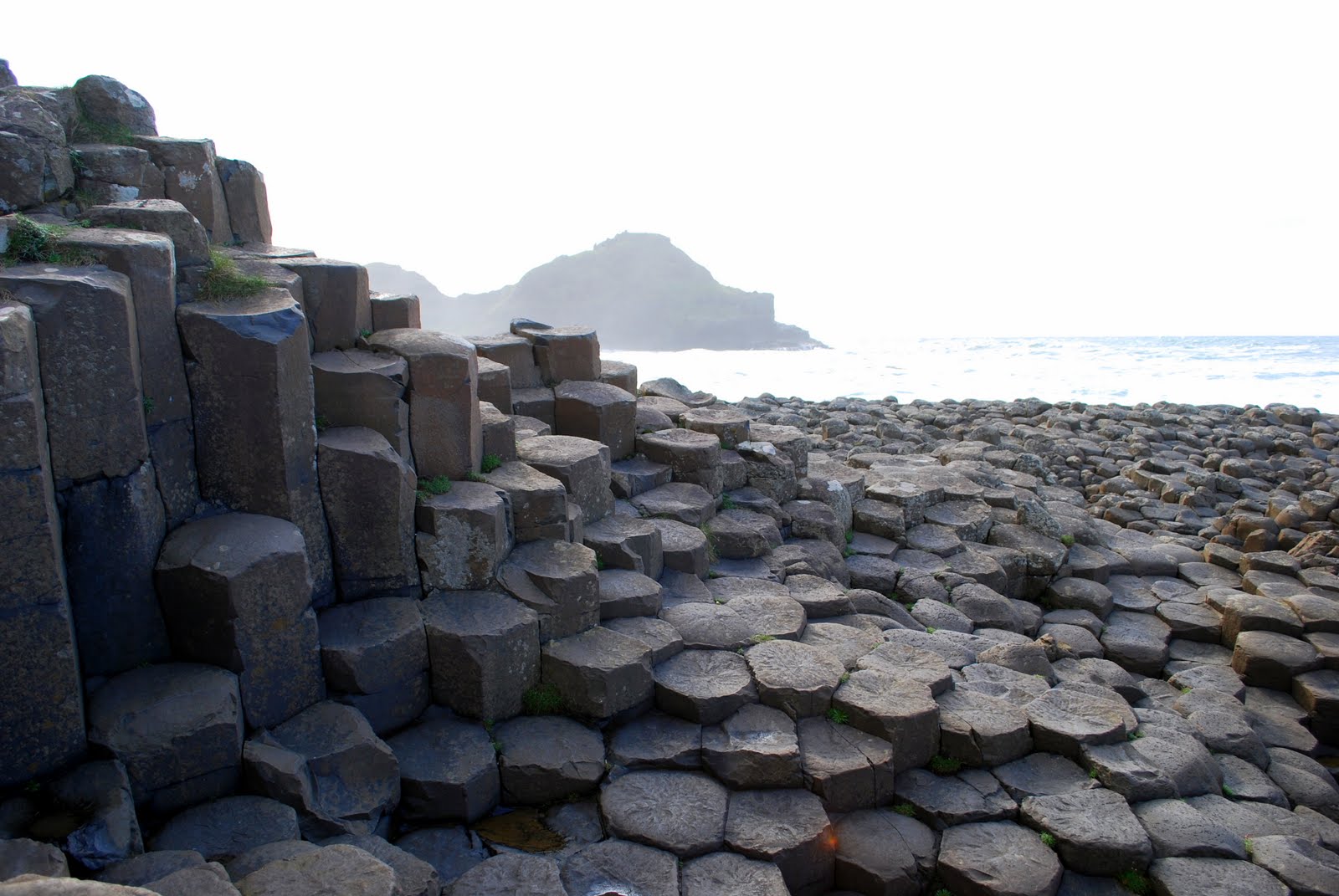
We walked along the shore until we reached The Giant's Causeway, which is an area of about 40,000 interlocking basalt columns, the result of an ancient volcanic eruption.


The Giant's Causeway was declared a World Heritage Site by UNESCO in 1986, and a National Nature Reserve in 1987 by the Department of the Environment for Northern Ireland.


In my opinion it is one of the most remarkable places I've ever seen and I was thrilled to see it again!
As with many places of interest in Ireland, there is a legend behind the Giant's Causeway.  Here it is according to the Causeway Coast and Glens website:

"The legend tells us that the Irish Giant Finn McCool had a rival - a Scottish giant named Benandonner. Finn McCool decided to build a causeway to Scotland so that he could challenge his adversary in battle. When the work was completed, the causeway stretched from North Antrim to Staffa.


Bennandonner accepted the invitation to walk over to Ireland and fight for supremacy. As Benandonner appeared over the horizon, Finn McCool realised in horror that he had taken on a rival much bigger than himself. He ran home to his wife, Oonagh. What to do?


The quick thinking Oonagh disguised Finn as a baby and made him curl up in an enormous cradle. Benandonner - faced with the sight of this huge ‘child’ took fright at the thought of the size of his father and fled back to Scotland tearing up the causeway in his wake."


The Giant's Causeway is owned and managed by the National Trust and it is the most popular tourist attraction in Northern Ireland.


I sat on the top of this little hill, on a comfortable stone seat, and filmed this:


I hope you enjoyed seeing and hearing the crashing sea of the Giant's Causeway in my video!


As if this day of touring the Causeway Coastal Route was not magical enough, look at how it ended -- I saw a rainbow in the sky!  I can only hope it means I will return again one day to tour again one of the most beautiful places on earth.

Linking up with Mary's "Mosaic Monday" event on her blog the Little Red House. Thanks, Mary!
Also linking tio Susan's Outdoor Wednesdat event on her blog A Southern Daydreamer.  Thanks, Susan!

Bookmark and Share