Showing posts with label Secret Gardens In NYC. Show all posts

Green Gardening in Wagner Park, Battery Park City


Do you see the greenbelt of trees along the Hudson River in the borough of Manhattan in New York City?  This is part of Battery Park City Park, which is 36 acres of open public space in lower Manhattan.  It contains parks, gardens, plazas, playgrounds, playing fields and walkways. It is all man made land, built entirely on landfill, and on a platform extending into the Hudson River. The Battery Park City Conservancy (BPC Parks) is a non-profit organization supported mainly by the residents of Battery Park City and its commercial and residential developers, as well as by the Battery Park City Authority. (all photos will enlarge when clicked on once, and then again when they open in a new page)


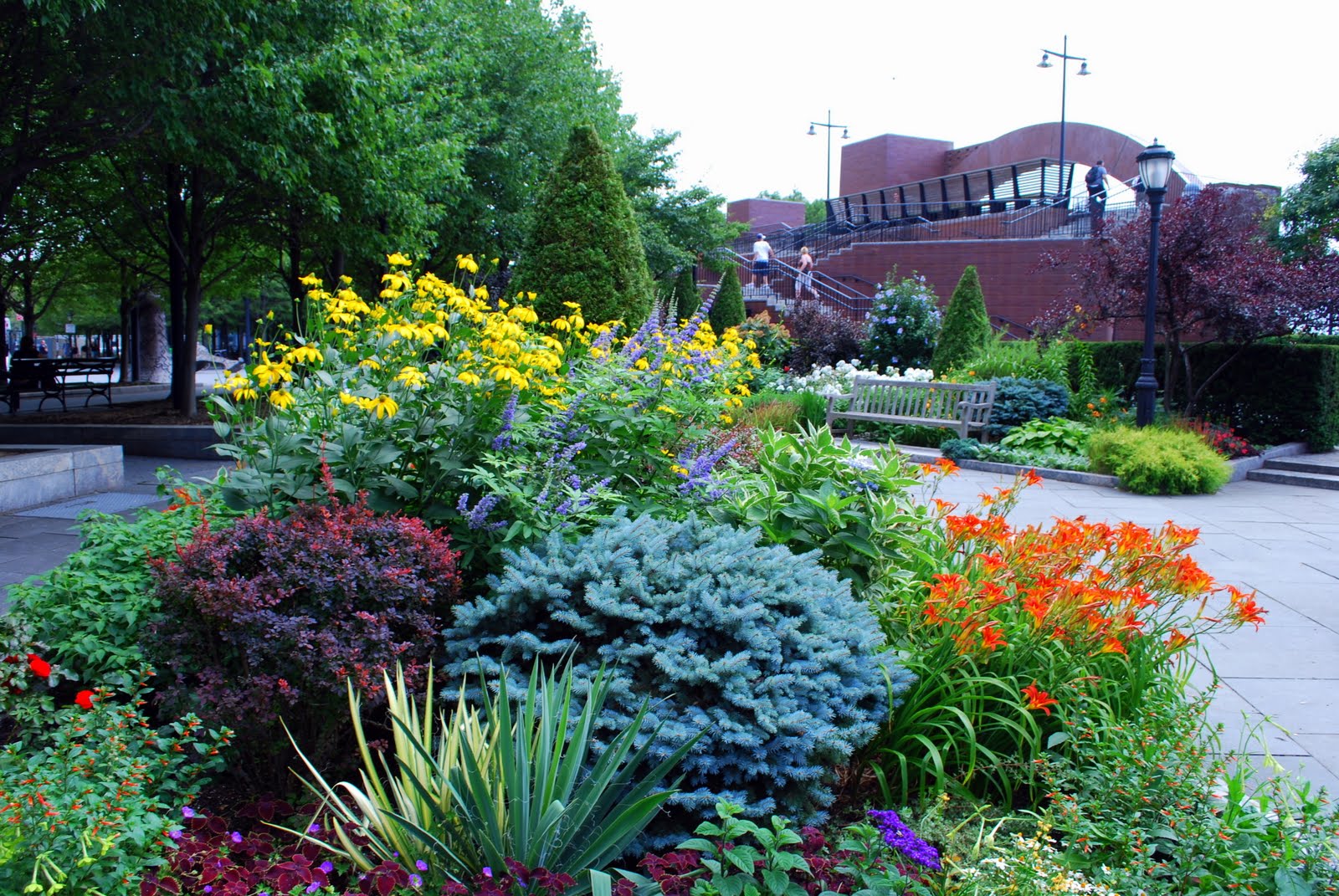
Just north of Battery Park on Battery Place between West Street and First Place, Robert F.Wagner, Jr. Park occupies a gorgeous setting on the Hudson River, with views across the water to the Statue of Liberty. It’s a lovely combination of grassy lawns, colorful gardens, and walking paths.


The Park Pavilions contain the Gigino Ristorante I blogged about in my prior post, and its public roof deck affords breathtaking views of the Statue of Liberty and New York Harbor.


Wagner Park is also the location of the Museum of Jewish Heritage, located at 36 Battery Place.


The park is a magical "secret garden" full of lush plantings, winding paths, cool fountains and benches on which to sit and rest amongst the blooming perennial flower beds and shrubs.

BPC maintains the parks and gardens in a fully organic "Green" manner, without the use of toxic pesticides, fertilizers, fungicides or herbicides.  Nearly all the organic matter incorporated in the soils comes in the form of compost, which is composed of plant wastes gathered throughout the community, vegetables wastes collected from local grocers and restaurants, and horse manure provided by the mounted police.

The compost is manufactured in a compact, high efficiency facility and is applied to the planting beds twice annually.


The conservancy uses a natural system of pest control which utilizes beneficial insects such as Tichogamma wasps, lady beetles, pirate bugs, lace wings and predator mites. The BCP staff and volunteers closely monitor the health of the plants and at the first sign of stress they check to see if beneficial insects are present. If not they may respond with the least invasive treatment possible, ranging from removing the insects by hand to applying insecticidal soaps or oils.


As you can see from these two photo mosaics of flowers I found growing in Wagner Park the Battery Park Conservancy does a wonderful job making the park ablaze with beautiful color!


The hibiscus flowers were as large as dinner plates! 


It is a wonderful place to sit on a warm summer day to enjoy a bit of shade and to enjoy some quiet nature in New York City.


In my next blog post we'll walk along the Esplanade which runs the entire length of Battery Park City, along the Hudson River. 


I think you'll be amazed by its beauty and the wonderful sights we see along the way!


I'm adding this post to "Mosaic Monday" on Mary''s blog Little Red House. Please visit Mary to view her beautiful mosaic and to see the links to other blogs participating on Monday.


Bookmark and Share

The New York Marble Cemetery


An interesting place I visited in Spring, but did not had time to blog about until today, is The New York Marble Cemetery, located at 41 and 1/2, Second Avenue, in the borough of Manhattan.  It is a small burial ground in Manhattan's East Village, and it is the oldest public non-sectarian cemetery in New York City.

(All photos can be enlarged for easier viewing by clicking on them once, and then again when they open on a new page. Use your browser's back arrow to return to the post.)


An informational plaque located on the front gates.  

The cemetery is usually open to visitors on fourth Sundays, April through October, from 11 until 3, as well as several other weekends throughout the year - check the schedule on this link.


Most of the cemetery is shielded from the avenue by the buildings that have sprung up around it over the years. Enter from 2nd Avenue between 2nd and 3rd Streets through a circa 1908 wrought iron gate. It leads to a walkway that is one hundred feet long leading to a circa 1854 gate with cast iron decoration .


Once inside you can see a large open garden space covered by grass.  An exhibition about the history of the cemetery was going on at the time of my visit. The cemetery was incorporated in 1831 in response to fears about yellow fever outbreaks at the time, when legislation had outlawed earth graves.  Marble vaults the size of small rooms were built ten feet underground in the excavated interior of the half acre of land that comprises the cemetery.


According to the cemetery's web site: "Half of the older caskets were tiny, holding children aged six and under. Contagious diseases such as scarlet fever, measles and whooping cough, as well as infections for which there were not yet antibiotics (erysipelas, pneumonia, cholera, etc.) contributed to a level of early mortality fortunately forgotten in most parts of the world. What would be termed symptoms today were then considered primary causes of death: dropsy (edema), congestion or inflammation of the lungs or brain, and dysentery or diarrhœa. For adults, the leading cause of death by far was tuberculosis, then known as consumption or phthisis pulmonalis. A surprising number of people who reached maturity, however, lived into their eighties and nineties, and invariably died of 'old age.' "


The walls of the cemetery are made from Tuckahoe marble, which was also used for the vaults, plaques and lintels, and gave the cemetery its name. Unfortunately, the marble is relatively soft material and many of the walls are rapidly disintegrating from time and acid rain.  Funds are being raised by the cemetery's board of trustees for the constant upkeep and renovations needed to preserve the cemetery.


All of the vaults are underground and the only name and vault makers are tablets like these on the walls.


Please enlarge this photo of a diagram that shows what the procedure for burial in the underground vaults would entail.


Above and below are part of the display in the cemetery the day I visited that shows portraits of the many of first people buried in the New York Marble Cemetery. 


One of the illustrious people buried in the cemetery is Doctor David Hosack, 1769-1835.  He was one of New York's most famous citizens of the time. Hosack was a founder of several New York institutions that survive to this day, including Bellevue Hospital and The New York Historical Society, and was a friend and confidante of some of the more distinguished citizens of the early Republic, including General Alexander Hamilton.  As the attending physician at the General’s duel with Aaron Burr in 1804, he cared for Hamilton in his last hours on earth. When Hosack bought a vault at the marble cemetery a few years before his death, other early New Yorkers flocked to do the same and, before too long, the cemetery had became the place to be buried in Manhattan.

By 1838, rural cemeteries, such as Green-Wood Cemetery in Brooklyn, quickly became the preference of most New York families, and soon the use of the Marble Cemetery declined. Most of the 2,070 interments took place between 1830 and 1870.  Now the cemetery’s quiet, half-acre grounds are available for rent for appropriate private or corporate events.

I found it a fascinating place to visit and another unexpected quiet green space amongst the bustling city streets. It was interesting to reflect upon the men and women buried there who were so influential in early New York history. Although I've lived in New York City my entire life I am constantly amazed by new discoveries that I make sometimes just by walking down a different street.  There is always something new to learn in this great city!


Bookmark and Share

Saint Mark's Church In The Bowery, East Village NYC


I read this fascinating historical book recently about an almost forgotten period in American history, called "The Island at the Center of the World." It is about the Dutch colony of New Netherlands that was located on the east coast of North America in the seventeenth century for over fifty years, until the English gained control of it in 1664, and turned its capital, New Amsterdam, into New York City.  Journalist and historian Russell Shorto was inspired to write this book when he learned about the New Netherlands Project which is based at the New York State Library in Albany, New York. For the last 30 years historian and linguistic scholar, Charles Gehring, has been translating 400 year old documents from New Amsterdam that were stored in the library for the project, and Shorto then interpreted them into a enthralling tale of the beginnings of the greatest city in the world.

Inspired by this book, I went out to find a little bit of the Dutch history that I read about, and I took a trip into the East Village/Lower East side neighborhood of Manhattan to visit Saint Mark's Church in-the-Bowery, located at 131 East 10th Street, at the intersection of 10th and Stuyvesant Streets and 2nd Avenue.   It is located on the oldest site of continuous worship in New York City and it is the second oldest church in Manhattan.

The church history from it web site states: "The St. Mark’s Church and its yards are just a few reminders of the once vast “bouwerie,” or Dutch plantation, which Peter Stuyvesant, governor of New Amsterdam purchased in 1651 from the Dutch West India Company. When Stuyvesant died in 1672, his body was interred in a vault under the family chapel he’d had built in 1660. In 1793, Stuyvesant’s great-grandson, Petrus Stuyvesant, donated the chapel property to the Episcopal Church with the stipulation that a new chapel be erected and on April 25, 1795, the cornerstone of St. Mark’s Church in-the-Bowery was laid."


The site is officially listed on the National Register of Historic Places and was designated a New York City Landmark in 1966.


An information plaque on the exterior of the church giving a brief account of its history.
(All photos may be enlarged for easier viewing -- click on once and then again to enlarge full size.  Use your computer browser's back arrow to return to the post after viewing enlarged photo)


The bust of Peter Stuyvesant is located in the churchyard. He served as the last Dutch Director-General of the colony of New Netherland (New York) from 1647 until it was ceded provisionally to the English in 1664. The bust was designed by Dutch sculptor Toon Dupuis, and presented to St.Mark’s by Queen Wilhelmina of Holland and the Dutch Government on December 5, 1915.

After losing the New Amsterdam colony to the English, Stuyvesant was recalled to Holland. He later petitioned to return to his beloved renamed New York, and died here in 1672. He is entombed in a wall in the St. Mark’s Church east yard, and and six generations of his descendants are also found in the churchyard. The black marker in the photo above shows the location of his tomb.

"Here (Peter Stuyvesant) built a manor and chapel. Here he would live out his life and be buried, and here, over the parade of centuries, flappers, shtetl refugees, hippies and punks – an aggregate of local residents running from Trotsky to Auden to Charlie Parker to Joey Ramone – would shuffle past his tomb.

-- Russell Shorto, from his book "The Island at the Center of the World."


There are other historical notables buried in the churchyard, one being Daniel Tompkins, a former governor of New York (1807-1817) and Vice President of the United States (1817-1825).

Some contemporary Memorial plaques on the church facade in the east churchyard.

The church web site states: "Support for the arts is an integral part of St. Mark’s community-based mission. Poetry, theatre and dance have co-existed at St. Mark’s providing a neighborhood and national forum for original and provocative performances. W.H. Auden, William Carlos Williams, Edna St. Vincent Millay, Kahil Gibran, W.H. Auden and Allen Ginsberg have taken part in poetry readings. Isadora Duncan and Martha Graham danced at St. Mark’s, and Sam Shepard produced his first plays here. Today three innovative projects are housed at St. Mark’s: The Poetry Project, Danspace Project and Ontological-Hysteric Theater."


The Saint Mark's in-the-Bowery west churchyard is a lush green space in summer, shaded by a canopy of many trees. It is a little "secret garden" of sort, a quiet oasis where you can sit and rest and retreat from the crowded city. I think it's a fitting that it is known as "The Healing Garden."


A sign in the churchyard.

Another view of the west churchyard.  The white building in the rear is the historic Ernest Flagg Rectory of Saint Mark's. There were quite a few people enjoying a Sunday afternoon in the yard.


One of my favorite photos of the day: a beautiful red rose resting above the rusted iron fence of the churchyard.  In a place with so much history it was a small reminder to me to enjoy each precious moment, as life, and the world, are ever changing.


I'm adding this post to the weekly "Outdoor Wednesday"event on Susan's blog A Southern Daydreamer. Please visit Susan's blog today to see links to all the blogs participating with their wonderful outdoor posts.


Bookmark and Share